
Turkish Delight: The Confection With an Actual Founding Company Still Running

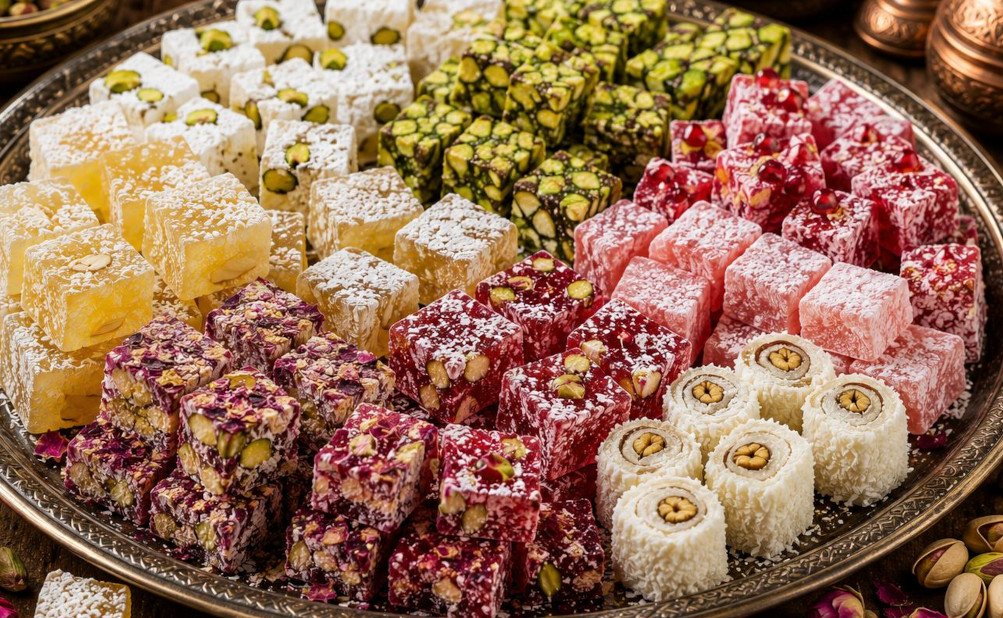
Country of origin: Turkey (Ottoman Istanbul)
Today’s random pick lands on Turkish delight, known in Turkish as lokum — small, soft, chewy cubes of starch-and-sugar gel, often flavored with rosewater, lemon, or mastic, studded with chopped pistachios or walnuts, and dusted in powdered sugar. Like İskender kebab, lokum comes with an unusually specific, well-documented commercial origin story, tied to a company that, remarkably, still exists and still makes the confection today.
A Confection Tied to One of Istanbul’s Oldest Businesses
Turkish delight’s modern form is closely associated with Bekir Efendi, a confectioner in late 18th-century Ottoman Istanbul, who’s widely credited with refining and popularizing the recipe using a technique that replaced honey-based sweeteners common in earlier confections with granulated sugar, which had become more widely available, and cornstarch as a setting agent, producing the smoother, more consistent, softer texture that came to define lokum as distinct from earlier, chewier Middle Eastern sweets. The confectionery business Bekir Efendi founded, known today as Hacı Bekir, has operated continuously in Istanbul since roughly 1777, making it one of the oldest continuously running confectionery businesses in the world, still producing lokum from a shop with direct lineage to the original founder.
From Ottoman Istanbul, lokum spread throughout the empire’s territory and, eventually, well beyond it, becoming particularly well known in Britain and much of Europe during the 19th century, where it picked up the English name “Turkish delight” — a name that stuck internationally even as the confection continued to be called lokum within Turkey itself.
Why Starch, Not Gelatin, Defines the Texture
What gives Turkish delight its distinctive soft, dense, slightly chewy texture — quite different from Western gummy candies or gelatin-based confections — comes down to the setting agent. Rather than gelatin, traditional lokum uses cornstarch (or sometimes wheat starch) cooked slowly with sugar and water until it thickens into a thick, glossy gel. This starch-based setting method produces a texture that’s softer and more yielding than a gelatin-set candy, without the springy, bouncy quality gelatin typically creates, and it also allows the confection to hold its shape at room temperature for extended periods without needing refrigeration, which mattered considerably in an era before reliable refrigeration was widely available.
A Name That Confused Western Audiences for Generations
The English name “Turkish delight” has arguably done the confection something of a disservice over the years, since it became so strongly associated in Western popular culture — notably through its prominent role in C.S. Lewis’s The Lion, the Witch and the Wardrobe — that many people in English-speaking countries encountered the idea of Turkish delight through fiction long before tasting an authentic version, and often formed impressions based on lower-quality, mass-produced Western imitations rather than the real thing. Authentic lokum, made with real rosewater, high-quality nuts, and proper starch-setting technique, is a considerably more nuanced and pleasant confection than the stiff, artificially flavored versions that gave the name a somewhat mixed reputation in parts of the English-speaking world.
The Recipe
Makes about 25 pieces
Ingredients
- 2 cups sugar
- 3 cups water, divided
- 1 cup cornstarch
- 1 teaspoon cream of tartar or lemon juice
- 1 tablespoon rosewater (or substitute lemon juice and zest for a citrus version)
- ½ cup chopped pistachios or walnuts (optional)
- Powdered sugar and additional cornstarch, for coating
Instructions
- Make the sugar syrup. In a saucepan, combine the sugar with 1 cup of water and the cream of tartar or lemon juice. Bring to a boil, stirring until the sugar dissolves, then let simmer gently while you prepare the starch mixture.
- Make the starch mixture. In a separate, heavy-bottomed pot, whisk the cornstarch with the remaining 2 cups of water until smooth, with no lumps. Cook over medium heat, whisking constantly, until it thickens into a thick, pudding-like paste.
- Combine. Slowly pour the hot sugar syrup into the thickened starch mixture, whisking constantly to keep it smooth. Reduce heat to low and continue cooking, stirring frequently to prevent scorching, for about 45 minutes to 1 hour, until the mixture turns a pale golden color and becomes very thick and glossy, holding its shape when a spoon is drawn through it.
- Add flavoring and nuts. Stir in the rosewater and chopped nuts if using, mixing thoroughly.
- Set the lokum. Pour the thick mixture into a greased baking dish lined with parchment paper, spreading it evenly. Let cool completely at room temperature, then refrigerate for at least 4 hours, or overnight, until fully set and firm.
- Cut and coat. Once set, turn the lokum out onto a cutting board dusted with a mix of powdered sugar and cornstarch. Cut into small cubes using a well-oiled knife, then toss the pieces in more of the powdered sugar and cornstarch mixture to coat and prevent sticking.
A Note on Cooking Time
The long, slow cooking time for the starch mixture is genuinely necessary — rushing this step with higher heat risks scorching the bottom before the mixture has properly thickened, and undercooking it will leave the lokum too soft and sticky to hold its shape once cut.
Serving Suggestions
Turkish delight is traditionally served alongside Turkish coffee, where its sweetness provides a pleasant contrast to the coffee’s strong, unsweetened bitterness, and it’s also commonly offered as a gesture of hospitality to guests.
Turkish delight’s continuous lineage back to a single 18th-century Istanbul confectionery is a rare thing in food history — a sweet whose origin isn’t just a story, but a business you can still walk into today.