
Döner Kebab: A Turkish Technique With a Disputed Berlin Chapter

Country of origin: Turkey, with a contested modern chapter tied to Berlin, Germany
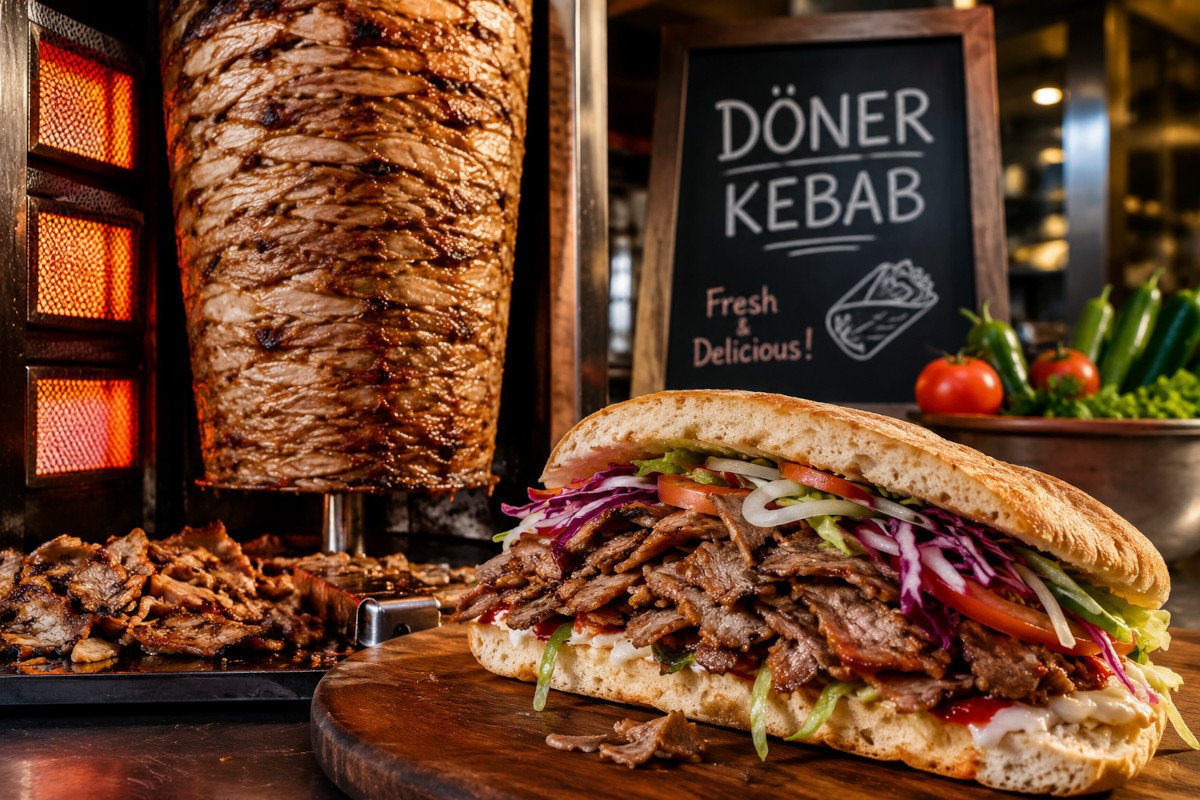
Thin-sliced, seasoned meat stacked on a vertical rotating spit and roasted slowly, the technique that sits at the root of shawarma and İskender kebab, both covered elsewhere on this blog. But döner’s story has an unusual modern twist that neither of those dishes shares quite as directly: a genuine, still-unresolved dispute over who exactly turned it into the sandwich most people around the world recognize today.
An Old Technique, a Newer Sandwich
The underlying döner technique — meat stacked and roasted on a vertical spit — is well established as a development from 19th-century Ottoman Anatolia, the same root technique discussed in relation to shawarma and İskender kebab. What’s disputed isn’t the spit-roasting method itself, but a more specific and more recent claim: who first took that roasted meat and served it inside flatbread as a portable, handheld sandwich, the format that’s now instantly recognizable on street corners worldwide.
The most widely repeated account credits Kadir Nurman, a Turkish immigrant working in Berlin, with introducing the döner kebab sandwich — meat, bread, and toppings combined into a single portable meal — around 1972, adapting the traditional plated döner into a format better suited to Germany’s fast-paced urban food culture and the practical needs of workers wanting a quick, cheap, filling meal they could eat on the go. This claim was significant enough that Nurman received public recognition in Germany for it during his lifetime, and Berlin has embraced a strong identity as the birthplace of the döner sandwich specifically, even hosting döner-focused food festivals and cultural celebrations built around that claim.
Why the Claim Is Genuinely Contested
That said, the Kadir Nurman origin story isn’t universally accepted, and it’s worth treating as a contested claim rather than settled fact. Other accounts and competing family claims — both within Germany’s large Turkish immigrant community and among some historians — argue that döner sandwiches in something close to their modern form may have already existed informally in Turkey itself before Nurman’s Berlin version, meaning the “invention” may have really been more a matter of popularizing and commercializing an existing informal practice rather than creating something entirely new from scratch. This kind of dispute is common with relatively recent food history, where oral tradition, competing business interests, and incomplete documentation make it genuinely difficult to assign clean credit, in contrast to older dishes whose origins have simply faded into settled legend over enough centuries.
Regardless of exactly how it happened, what’s not disputed is that döner kebab’s rise into one of Germany’s most popular fast foods, and eventually a global phenomenon, happened specifically through the Turkish immigrant community in Germany, particularly Berlin, making this a genuinely unusual case of a centuries-old Ottoman technique achieving its modern global form through 20th-century immigrant entrepreneurship in Europe rather than within Turkey or the wider Middle East itself.
The Recipe: Home-Style Döner Kebab
Serves 4–6
Ingredients
For the meat:
- 2 lbs boneless lamb or beef, thinly sliced
- ¼ cup plain yogurt
- 2 tablespoons olive oil
- 3 cloves garlic, minced
- 1 teaspoon ground cumin
- 1 teaspoon paprika
- ½ teaspoon ground coriander
- ½ teaspoon dried oregano
- Salt and black pepper, to taste
To assemble:
- 4–6 pieces flatbread or pita
- Shredded lettuce or cabbage
- Sliced tomato and onion
- Garlic sauce (toum) or a yogurt-based sauce
- Hot sauce or chili flakes (optional)
Instructions
- Marinate the meat. In a bowl, combine yogurt, olive oil, garlic, cumin, paprika, coriander, oregano, salt, and pepper. Add the thinly sliced meat and toss well to coat. Marinate in the refrigerator for at least 2 hours, or ideally overnight.
- Stack for cooking (optional approximation). If attempting to approximate the spit method, thread the marinated meat slices tightly onto skewers, pressing them into a compact stack, which helps replicate some of the self-basting effect of a true vertical rotisserie as it cooks.
- Cook. Heat a grill, grill pan, or wide skillet over high heat. Cook the meat in batches, in a single layer, for 2–3 minutes per side, until well-charred at the edges and cooked through.
- Warm the bread. Briefly warm the flatbread or pita on the grill or in a dry pan.
- Assemble. Layer the cooked meat onto the warm bread with shredded lettuce or cabbage, tomato, onion, and your choice of sauce. Add hot sauce or chili flakes if desired. Wrap or fold to eat.
A Note on the Sandwich Format
The sandwich version of döner is meant to be eaten immediately, wrapped tightly and held in the hand — resist the urge to over-fill it, since a döner packed too full tends to fall apart before you’re done eating it, undermining the whole point of a format designed for quick, portable eating.
Serving Suggestions
Döner is traditionally served as a wrap or stuffed into bread, though the same meat and toppings work equally well served over rice or salad as a more substantial plated meal for those who prefer eating with a fork.
Döner kebab’s journey from an Ottoman rotisserie technique to a Berlin street food phenomenon, with a still-debated inventor along the way, shows how even relatively recent food history can remain genuinely unsettled.