
Kleicha: The Cookie Iraq Considers Its National Sweet

Country of origin: Iraq
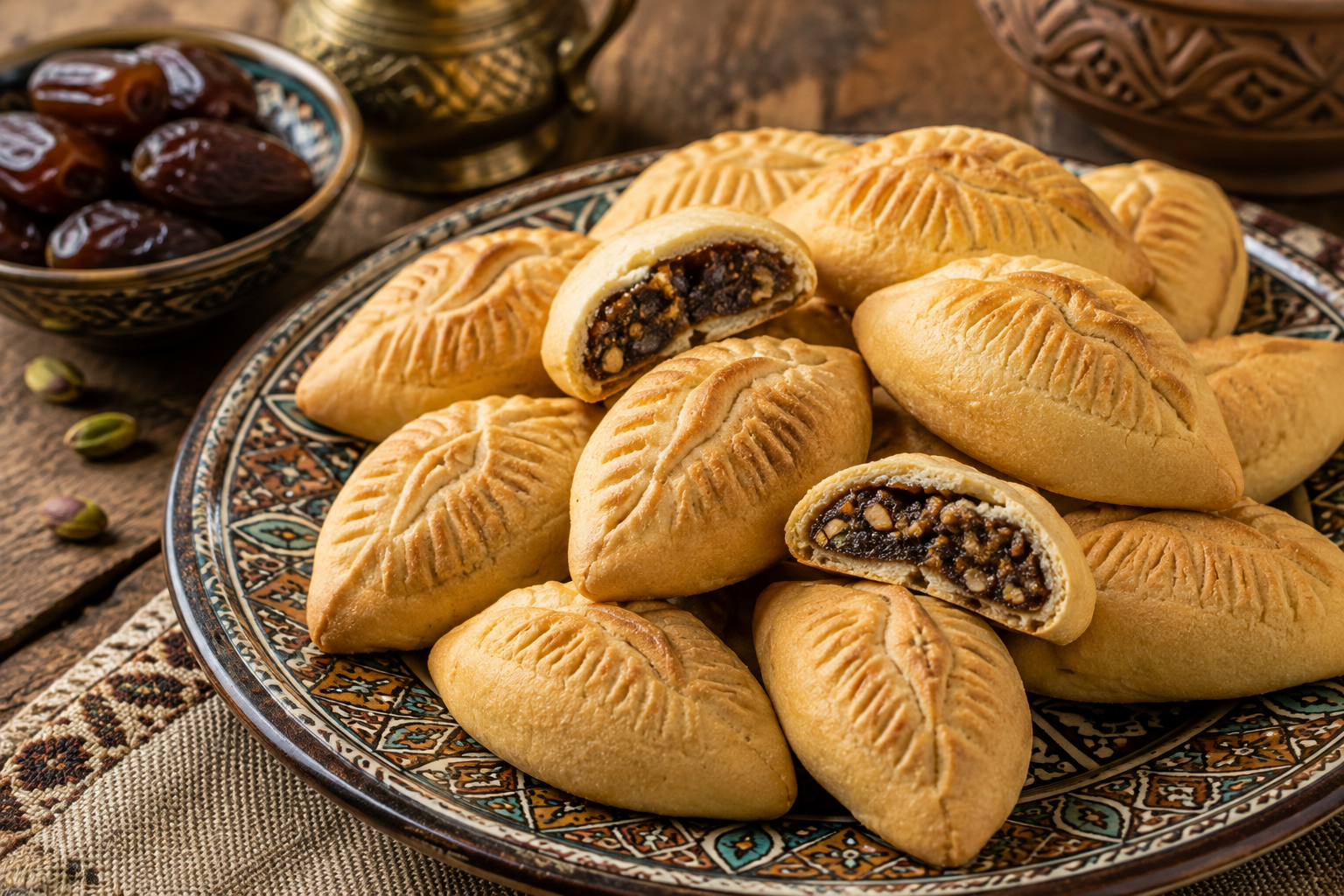
A soft, lightly sweetened pastry filled most traditionally with a thick date paste, though walnut and other nut-based fillings are common as well, shaped into rounds, crescents, or rings and often stamped with a decorative pattern before baking. Widely regarded as Iraq’s national cookie, kleicha holds a place in Iraqi food culture that goes beyond just being a well-liked sweet — it’s closely tied to specific religious holidays and carries genuine symbolic weight around hospitality and celebration.
A Cookie Central to Eid Celebrations
Kleicha is most strongly associated with Eid al-Fitr, the holiday marking the end of Ramadan, when Iraqi households traditionally prepare large batches in the days leading up to the celebration, often as a multi-day, multi-generational undertaking involving several family members working together, similar in spirit to how large batches of warak enab might be prepared collectively ahead of a gathering, discussed elsewhere on this blog. The scale of production during Eid reflects kleicha’s role not just as a treat for the immediate family but as something to be shared generously with neighbors, extended family, and guests, making it as much a gesture of hospitality and community connection as a dessert in its own right.
Beyond Eid specifically, kleicha is deeply enough embedded in Iraqi cultural identity that it’s sometimes described, only somewhat informally, as Iraq’s national cookie, a status that reflects both how widely it’s eaten across the country and its closely held association with Iraqi identity, including among the Iraqi diaspora, where kleicha remains a strong marker of cultural connection to home for many families now living abroad.
Date Paste, Not Whole Dates, Fills the Cookie
The most traditional and iconic filling for kleicha is a smooth, thick date paste, made by cooking down pitted dates, sometimes with a bit of butter, cardamom, and occasionally a touch of rosewater, until they break down into a spreadable, cohesive paste rather than staying in distinct pieces. This connects kleicha to the same deep regional tradition of date cultivation discussed in relation to luqaimat’s date syrup elsewhere on this blog, with dates serving as one of the most historically significant and widely available sweeteners across Iraq and the broader Gulf and Mesopotamian region for millennia. Using paste rather than whole or roughly chopped dates allows the filling to spread evenly and thinly inside the dough without creating lumps or uneven pockets, which matters for achieving the characteristic thin, even ratio of dough to filling that well-made kleicha is known for.
The Decorative Stamping Isn’t Just for Looks
A distinctive visual feature of kleicha, particularly the ring or round-shaped versions, is a decorative pattern pressed into the surface of the dough before baking, traditionally done using a specialized wooden tool called a kelaicha mold or, in less formal home settings, simply the tines of a fork or a similar household tool to create a repeating pattern. Beyond the visual appeal, this stamping actually serves a small functional purpose as well, since the shallow indentations help the dough bake slightly more evenly and can help prevent excessive puffing or cracking in spots as the pastry cooks, giving the cookies a more consistent, professional-looking finish alongside the decorative element.
The Recipe
Makes about 24 cookies
Ingredients
For the dough:
- 3 cups all-purpose flour
- ½ cup sugar
- 1 teaspoon instant yeast
- ½ teaspoon ground cardamom
- ¼ teaspoon salt
- ½ cup unsalted butter, softened
- ¼ cup vegetable oil
- ½ cup warm milk (approximate, as needed)
- 1 egg
For the date filling:
- 2 cups pitted dates
- 3 tablespoons butter
- ¼ teaspoon ground cardamom
- 2 tablespoons water, as needed
For finishing:
- 1 egg, beaten, for egg wash
- Sesame seeds, for topping (optional)
Instructions
- Make the date filling. In a saucepan, combine the pitted dates with butter, cardamom, and a splash of water. Cook over low heat, mashing and stirring frequently, until the dates break down into a smooth, thick, spreadable paste, about 10–15 minutes. Let cool completely.
- Make the dough. In a large bowl, combine flour, sugar, yeast, cardamom, and salt. Rub in the softened butter and oil until the mixture looks sandy. Add the egg and gradually mix in warm milk, kneading until you get a soft, smooth dough. Cover and let rest for about 1 hour in a warm place, until slightly puffed.
- Divide and fill. Divide the dough into small balls, about the size of a golf ball. Flatten each ball into a small disc, place a spoonful of date paste in the center, then fold the edges up and over to fully enclose the filling, pinching to seal and rolling gently back into a smooth ball or ring shape.
- Shape and decorate. Flatten each filled piece slightly and, if using a traditional kleicha mold, press it firmly to imprint the decorative pattern. Otherwise, use the tines of a fork to press a simple pattern into the surface.
- Egg wash and bake. Arrange the shaped kleicha on a baking sheet, brush with beaten egg, and sprinkle with sesame seeds if using. Bake at 350°F (175°C) for 20–25 minutes, until lightly golden.
- Cool and serve. Let cool on the tray for a few minutes before transferring to a wire rack to cool completely.
A Note on Sealing the Filling
Make sure the dough is fully sealed around the date filling before shaping and baking — any gaps can cause the filling to leak out and burn during baking, so take a little extra time pinching the edges closed completely.
Serving Suggestions
Kleicha is traditionally served with tea or Arabic coffee, and it keeps well at room temperature in an airtight container for several days, making it practical for the large batches typically prepared ahead of Eid celebrations.
Kleicha’s role during Eid, prepared in large batches and shared widely, shows how a single cookie can carry meaning well beyond its ingredients — as much about generosity and connection as it is about dates and dough.