
İskender Kebab: The Only Kebab Named After Its Inventor

Country of origin: Turkey (Bursa)
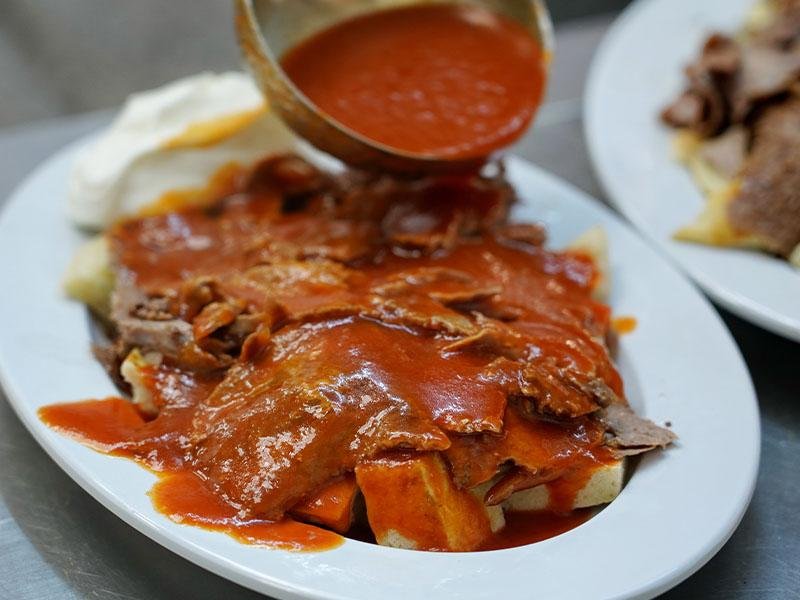
Today’s random pick lands on İskender kebab — thin-sliced döner meat laid over cubes of bread, smothered in tomato sauce, drizzled with browned butter, and served alongside yogurt. Unlike most dishes covered on this blog, whose origins are debated, contested, or lost to centuries of migration and adaptation, İskender kebab has an unusually specific, well-documented origin story: it’s named directly after the man who’s credited with inventing it.
A Dish With an Actual Named Inventor
İskender kebab traces its origin to Bursa, a city in northwestern Turkey, where a butcher and cook named İskender Efendi is credited with creating the dish in the late 19th century, generally dated to around 1867. According to the widely accepted account, İskender Efendi’s family had already been developing the vertical döner rotisserie technique, and he’s credited with the specific innovation of serving the sliced meat over bread cubes with tomato sauce and browned butter, rather than serving the döner meat plain or wrapped, as had been more typical up to that point. His descendants have continued running a restaurant in Bursa for generations, and that restaurant, along with several others in the city, still claims direct lineage to the dish’s original creation.
This makes İskender kebab a genuinely unusual case among Middle Eastern and Turkish dishes: rather than a food shaped gradually over centuries by migration, trade, and countless anonymous home cooks, it has a specific claimed inventor, a specific city, and a reasonably specific decade, all still actively associated with a real, operating family business today.
Building on an Older Technique
While İskender Efendi is credited with the specific presentation that bears his name, it’s worth noting that the underlying döner technique — thin-sliced meat stacked and roasted on a vertical rotating spit — was already established Ottoman cooking technology by the time he made his contribution, the same lineage of technique discussed in relation to shawarma elsewhere on this blog. İskender kebab’s real innovation, then, wasn’t the meat-cooking method itself, but the specific way of serving and dressing it — layering it over bread, tomato sauce, and browned butter — that turned a familiar cooking technique into a distinct, newly named dish with its own identity.
Why the Browned Butter Matters
The finishing touch of hot, browned butter (or sometimes a mix of butter and tomato-based sauce) poured directly over the assembled dish just before serving is one of İskender kebab’s most distinctive details, and it serves a real functional purpose beyond flavor. Pouring the hot butter over the dish right before serving keeps everything — the meat, the bread underneath, and the tomato sauce — warm and glistening, while also softening the bread cubes slightly as they soak up both the butter and the meat’s juices. This is part of why İskender kebab is very much a dish meant to be eaten immediately once assembled and sauced, rather than one that holds well after preparation.
The Recipe
Serves 4
Ingredients
For the meat:
- 1 ½ lbs lamb or beef, thinly sliced (or ground and shaped, if a home rotisserie isn’t available)
- 2 tablespoons olive oil
- 2 cloves garlic, minced
- 1 teaspoon paprika
- ½ teaspoon ground cumin
- Salt and black pepper, to taste
For the tomato sauce:
- 2 tablespoons olive oil
- 2 cloves garlic, minced
- 1 can (15 oz) crushed tomatoes
- ½ teaspoon paprika
- Salt and black pepper, to taste
To assemble:
- 3–4 pieces pide or thick pita bread, cut into cubes
- 4 tablespoons butter
- 1 cup plain yogurt
- Fresh parsley, chopped, for garnish
Instructions
- Marinate the meat. Toss the thinly sliced meat with olive oil, garlic, paprika, cumin, salt, and pepper. Let marinate for at least 30 minutes, or up to overnight in the refrigerator.
- Make the tomato sauce. In a saucepan, heat olive oil over medium heat, add garlic, and cook briefly until fragrant. Add crushed tomatoes, paprika, salt, and pepper, and simmer for 15 minutes until slightly thickened.
- Cook the meat. Heat a grill pan or wide skillet over high heat and cook the marinated meat in batches, searing quickly for 2–3 minutes per side, until well-charred at the edges and cooked through. This approximates the crisp, charred quality of thinly shaved döner meat without a vertical rotisserie.
- Toast the bread. Lightly toast the bread cubes in a dry pan or under a broiler until slightly crisp on the outside but still soft inside.
- Melt the butter. In a small pan, melt the butter over medium heat and cook for 1–2 minutes, just until it turns a light golden color and smells nutty. Remove from heat immediately to avoid burning.
- Assemble. Arrange the toasted bread cubes on a serving platter. Spoon the warm tomato sauce generously over the bread. Layer the cooked meat on top.
- Finish and serve. Pour the hot browned butter directly over the assembled dish just before serving. Serve immediately with yogurt on the side and a scatter of fresh parsley.
A Note on Serving Speed
İskender kebab is genuinely best eaten within a few minutes of assembly, while the bread is still warm and just beginning to soak up the sauce and butter without turning fully soggy — this isn’t a dish that holds well or reheats particularly gracefully.
Serving Suggestions
Traditionally, a spoonful of yogurt is placed either on the side or directly on top of the dish, providing a cooling, tangy contrast to the rich butter and warm tomato sauce.
İskender kebab stands out among Turkish and Middle Eastern dishes for having an actual name attached to its creation — proof that, occasionally, food history does leave behind a clear, traceable signature.