
Bamia: The Okra Stew That Splits Opinion Along Texture Lines

Country of origin: Widely shared across the Levant, Egypt, Iraq, and the Gulf
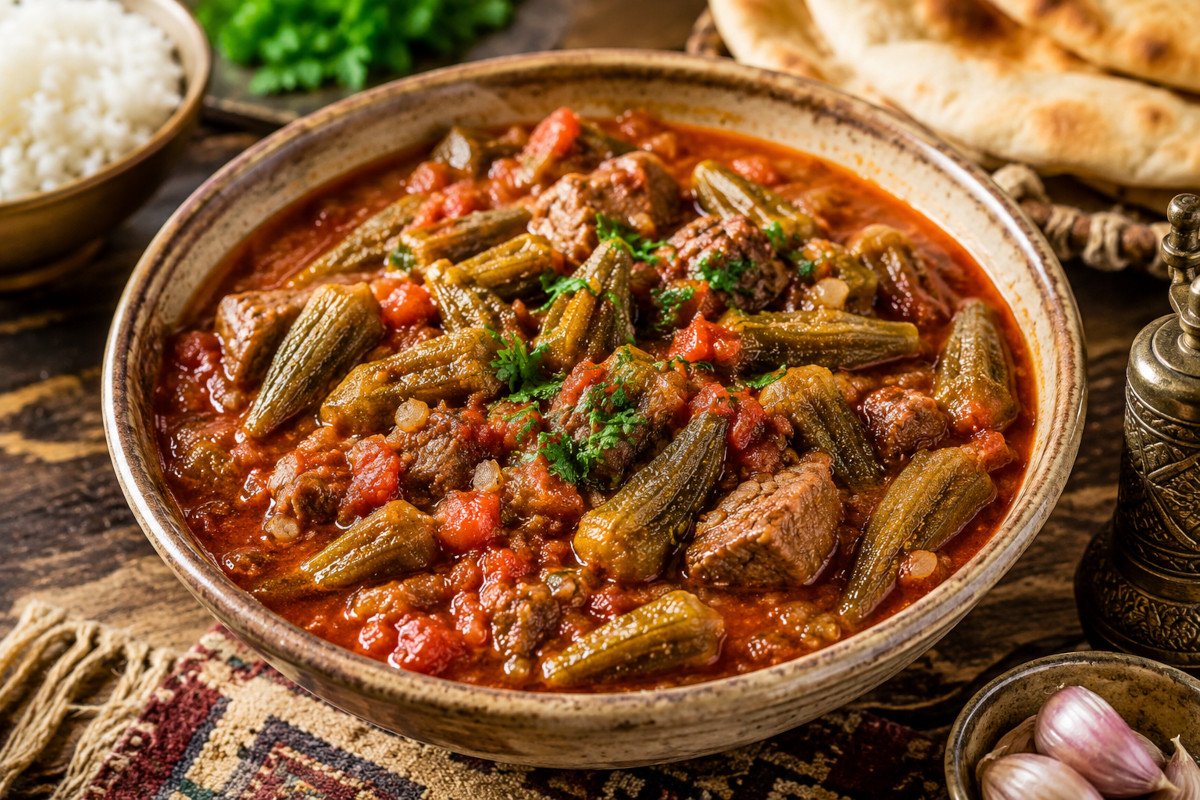
Bamia is a tomato-based stew built around okra, slow-simmered with meat (usually lamb or beef) until the sauce thickens and the okra softens completely. Alongside mulukhiyah, it’s one of the clearer examples in Middle Eastern cooking of a dish whose most defining trait — a naturally slippery, mucilaginous texture — is exactly the thing that divides people into strong camps of either loving or actively avoiding it.
A Dish Shared Widely, With No Single Claimed Origin
Unlike some of the dishes covered on this blog, bamia doesn’t come with a single, widely repeated origin story tied to one city or ruling dynasty. Instead, it’s better understood as a shared regional stew, appearing with only minor variation across Egypt, the Levant, Iraq, and the Gulf states, reflecting how widely okra has been cultivated and cooked across the broader Middle East and North Africa for a very long time. Okra itself is believed to have originated in the Horn of Africa region, spreading through Egypt and the wider Arab world via historical trade and agricultural exchange over many centuries, eventually becoming embedded deeply enough in the region’s cooking that bamia today feels like a genuinely native dish in each of the countries that claim it, rather than a recent import.
Because it’s so widely shared, bamia varies more by household and regional preference than many of the more tightly defined dishes covered elsewhere on this blog — some versions include whole small okra pods, others slice them, some use lamb, others beef, and the exact spicing shifts noticeably as you move from an Egyptian kitchen to an Iraqi one to a Palestinian one.
Managing (or Embracing) the Sliminess
As with mulukhiyah, okra’s natural mucilage — a slippery, viscous compound released when the vegetable is cut and cooked — is the single most divisive element of bamia, and how a cook handles it says a lot about their approach to the dish. Several practical techniques exist to reduce the sliminess for those who prefer a less viscous stew: cooking the okra whole rather than sliced significantly reduces how much mucilage releases into the sauce, since the cut surface area is what triggers the release. Briefly frying or roasting the okra before adding it to the stew, rather than simmering it directly in liquid from the start, also meaningfully reduces sliminess by partially cooking off some of that mucilage before it has a chance to thicken the sauce. Adding a splash of vinegar or lemon juice either during cooking or right at the start is another commonly used technique believed to help cut down on the slippery texture.
That said, in many households, the slight thickness okra lends to the stew’s sauce is considered a feature rather than a flaw, contributing to bamia’s characteristically rich, clingy sauce texture that coats rice particularly well — meaning not everyone making bamia is actually trying to minimize the mucilage at all.
The Recipe
Serves 4–6
Ingredients
- 1 lb small, whole fresh okra (or frozen whole okra), trimmed
- 2 tablespoons olive oil, plus more for pre-cooking the okra
- 1 lb lamb or beef stew meat, cut into chunks
- 1 large onion, chopped
- 4 cloves garlic, minced
- 1 can (28 oz) crushed tomatoes
- 1 teaspoon ground coriander
- ½ teaspoon ground cumin
- ¼ teaspoon cinnamon
- 1 tablespoon lemon juice or a splash of vinegar
- Salt and black pepper, to taste
- 2 cups water or broth
- Fresh cilantro, chopped, for garnish
Instructions
- Pre-cook the okra. In a separate pan, lightly fry or roast the whole okra in a bit of olive oil over medium-high heat for about 5–7 minutes, until it develops some light browning on the outside. This step meaningfully reduces the sliminess in the final stew. Set aside.
- Brown the meat. In a large pot, heat 2 tablespoons of olive oil over medium-high heat. Season the meat with salt and pepper and brown on all sides, about 8 minutes. Remove and set aside.
- Build the base. In the same pot, add the onion and cook until soft, about 8 minutes. Add garlic and cook for another minute. Stir in the crushed tomatoes, coriander, cumin, and cinnamon.
- Simmer the meat. Return the browned meat to the pot, add water or broth, and bring to a simmer. Cover and cook on low heat for about 1 hour, until the meat is tender.
- Add the okra. Add the pre-cooked okra to the pot and continue simmering, uncovered, for another 15–20 minutes, until the okra is fully tender and the sauce has thickened.
- Finish. Stir in lemon juice or vinegar, and adjust salt and pepper to taste.
- Serve. Garnish with fresh cilantro and serve hot over white rice.
A Note on Okra Selection
Smaller okra pods are generally more tender and less fibrous than larger ones, which can become tough and stringy. If using fresh okra, look for firm, bright green, smaller pods for the best texture in the finished stew.
Serving Suggestions
Bamia is traditionally served over rice, which absorbs the rich, tomato-based sauce well, and pairs nicely with a simple side salad to add some fresh, crisp contrast to the stew’s soft texture.
Bamia’s shared identity across so many countries, without a single claimed origin, reflects just how deeply okra became embedded in the region’s everyday cooking — a dish less about any one culture’s ownership than about a shared, well-worn kitchen habit.