
Muhammara: Aleppo’s Fiery Red Pepper and Walnut Dip

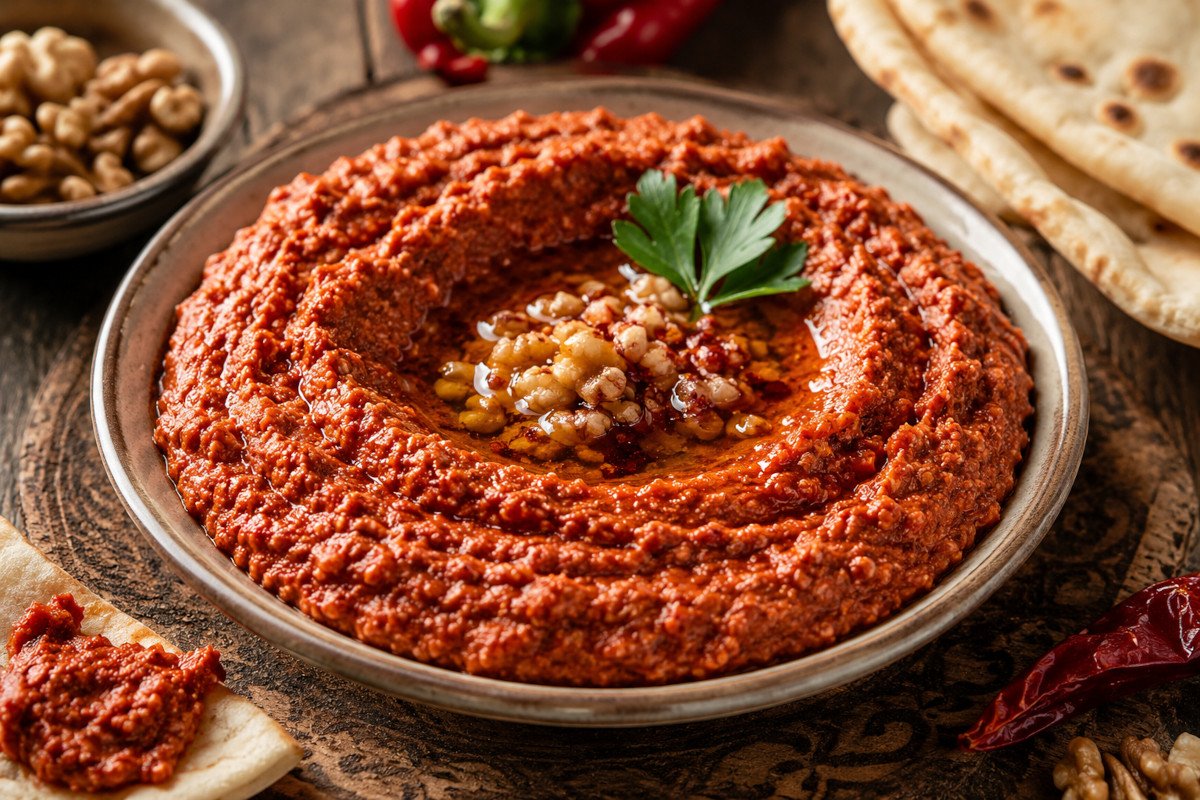
Today’s random pick lands on muhammara — a thick, deep red dip made from roasted red peppers, ground walnuts, pomegranate molasses, and Aleppo pepper, hailing from Aleppo, Syria, a city historically renowned as one of the great culinary centers of the Middle East. Where hummus leans creamy and mild, muhammara is bold, smoky, sweet-tart, and quietly spicy all at once — a dip built for people who want more going on in a single bite.
Aleppo: A City Built on Trade and Flavor
To understand muhammara, it helps to understand Aleppo itself. For centuries, Aleppo sat at a major crossroads of Silk Road trade routes connecting Anatolia, Persia, and the Mediterranean, and that position shaped it into one of the most sophisticated culinary cities in the Arab world, with a reputation for refined, spice-forward cooking that rivaled Damascus and even Istanbul. Muhammara is often cited as one of Aleppo’s signature culinary exports, alongside the city’s namesake Aleppo pepper, which remains one of the most prized chili varieties in Middle Eastern cooking.
The dish’s exact age is hard to pin down precisely, but red pepper and walnut combinations appear in Ottoman-era culinary traditions across the empire, and Aleppo’s central role in that trade network likely helped establish the city’s version as the most well-known and widely replicated today, particularly following the Syrian diaspora that has carried the dish, along with much of Aleppo’s culinary heritage, to cities around the world in recent decades.
The Pepper That Defines the Dish
Aleppo pepper (also called pul biber in some regional contexts) is central to muhammara’s identity — a moderately spicy, dried and crushed chili with a fruity, slightly tangy, sun-dried flavor that’s noticeably different from more common chili flakes. It brings warmth without overwhelming heat, sitting at a moderate spice level that lets the other flavors in the dip come through rather than dominating them. True Aleppo pepper has become harder to source reliably in recent years due to the conflict in Syria, and Turkish-grown versions or reasonable substitutes like a mix of paprika and a small amount of cayenne are commonly used today when the genuine article isn’t available.
Balancing Sweet, Sour, Smoky, and Spicy
What makes muhammara distinctive is how many different flavor notes it holds together in a single dip. Roasted red peppers bring natural sweetness and a smoky depth, especially if charred directly over a flame before blending. Toasted walnuts add richness and a slightly bitter, earthy undertone. Pomegranate molasses contributes a tart, syrupy sourness that cuts through the richness of the nuts. And Aleppo pepper ties it all together with gentle heat and a fruity edge. Getting the balance right — none of these elements overpowering the others — is really the entire skill of making a good muhammara, more than any complicated technique.
The Recipe
Makes about 2 cups
Ingredients
- 3 large red bell peppers (or 1 ½ cups jarred roasted red peppers, well drained)
- 1 cup walnuts, toasted
- ½ cup breadcrumbs (or a slice of stale bread, torn)
- 2 tablespoons pomegranate molasses
- 1 tablespoon Aleppo pepper (or 2 teaspoons paprika mixed with ½ teaspoon cayenne)
- 2 tablespoons olive oil, plus more for drizzling
- 1 clove garlic
- 1 teaspoon ground cumin
- ½ teaspoon salt, plus more to taste
- 1 teaspoon lemon juice
- 1 teaspoon sugar or pomegranate molasses (to balance, if needed)
Instructions
- Roast the peppers. If using fresh bell peppers, char them directly over a gas flame, under a broiler, or on a hot grill, turning occasionally, until the skin is blackened all over, about 10–15 minutes. Place in a covered bowl or sealed bag for 10 minutes to steam, then peel off the charred skin, remove the seeds and stem, and roughly chop the flesh.
- Toast the walnuts. If not already toasted, spread the walnuts on a baking sheet and toast at 350°F (175°C) for 8–10 minutes, until fragrant. Let cool slightly.
- Blend the base. In a food processor, combine the roasted peppers, toasted walnuts, breadcrumbs, pomegranate molasses, Aleppo pepper, olive oil, garlic, cumin, and salt. Pulse until you get a thick, coarsely textured paste — muhammara should have some texture from the walnuts, not be perfectly smooth like hummus.
- Adjust the balance. Taste and adjust with lemon juice for brightness, more salt if needed, and a touch of sugar or extra pomegranate molasses if the mixture tastes too tart or too spicy without enough sweetness to balance it.
- Rest before serving. Let the muhammara sit for at least 20–30 minutes before serving, which allows the flavors to meld and deepen. It also keeps well refrigerated for several days, with the flavor generally improving after a day.
- Serve. Transfer to a serving dish, drizzle generously with olive oil, and optionally sprinkle with a few extra chopped walnuts and a pinch of Aleppo pepper on top.
A Note on Texture
Resist the urge to over-process the mixture into a completely smooth paste — muhammara is meant to have some bite and texture from the walnuts, which is part of what distinguishes it from smoother dips like hummus or baba ganoush.
Serving Suggestions
Muhammara is traditionally served as part of a mezze spread, with warm pita or flatbread for scooping. It also works well as a spread on sandwiches or alongside grilled meats, where its sweet-tart intensity cuts nicely through richer, fattier flavors.
Muhammara carries the flavor of Aleppo’s history as a trading crossroads in a single dip — proof that some of the best recipes come from cities built around the exchange of ideas, spices, and flavor.