
Halva: The Sesame Confection That’s Really a Sugar Science Experiment

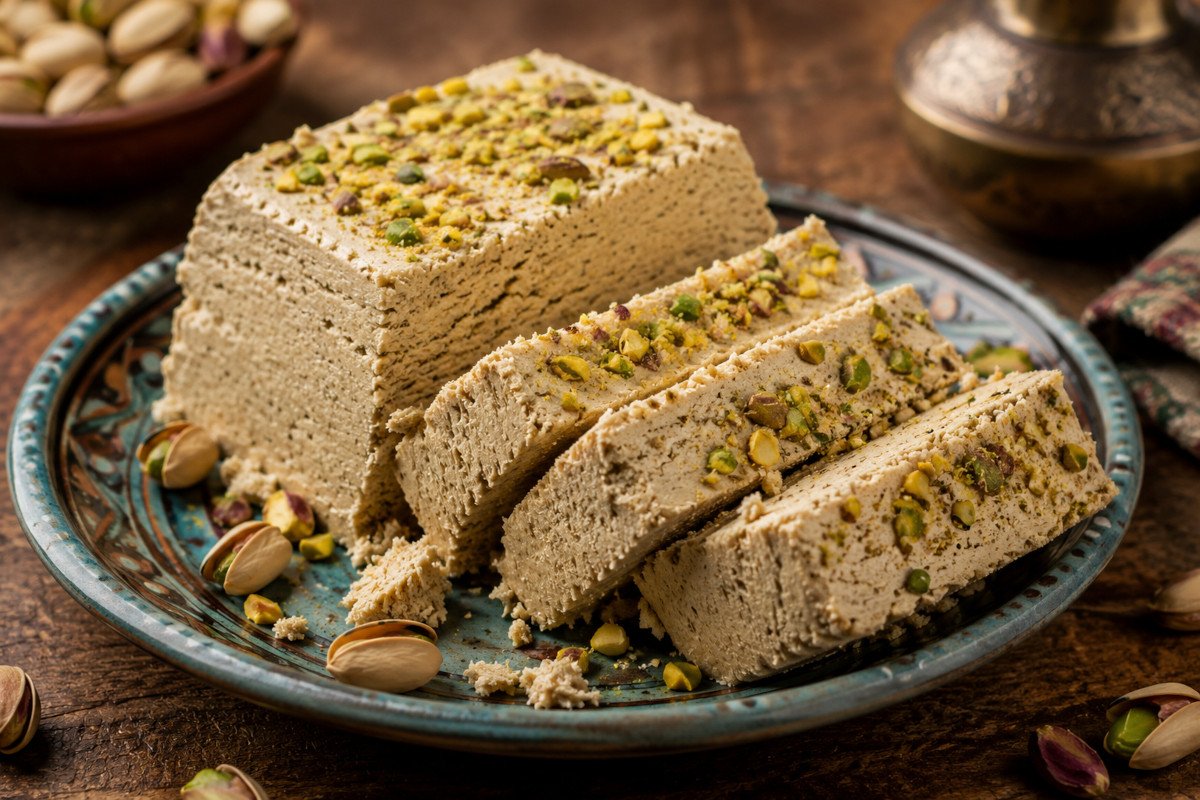
Country of origin: Widely shared across the Middle East, with roots likely tracing back to Persia
This round’s pick is halva (also spelled halawa or halvah) — a dense, crumbly, sweet confection made primarily from tahini and sugar syrup, sometimes studded with pistachios or swirled with chocolate or a fruit paste. It’s one of the oldest and most widely distributed sweets in the region, found under variations of the same name from Iran through the Levant, Turkey, and well beyond, and its distinctive texture is the result of a genuinely specific piece of sugar chemistry that most people eating it have never thought about.
A Name and Concept That Spread Extraordinarily Far
The word “halva” derives from an Arabic root meaning “sweet,” and it’s worth noting upfront that “halva” isn’t really the name of one single dish — it’s used across an enormous geographic range, from Iran and the Arab world through Turkey, the Balkans, and even into South Asia, to describe a broad category of dense, sweet confections that can vary considerably in base ingredient, from the tahini-based version most associated with the Middle East to semolina-based versions common in Turkey and parts of South Asia, to versions built from flour, carrots, or other bases entirely in different regional traditions. The specific tahini-based halva most closely associated with the Middle East and the Eastern Mediterranean is generally believed to have roots reaching back to Persia, though, as with many foods that spread this widely and this long ago, pinpointing an exact origin point with certainty is genuinely difficult given how far back and how broadly the basic concept traveled.
Sugar Crystallization Is the Whole Texture Story
What gives tahini-based halva its distinctive dense, slightly crumbly, almost fibrous texture — quite different from a smooth candy or a soft fudge — comes down to controlled sugar crystallization, a genuinely specific technical process. Halva is made by combining hot sugar syrup with a whipped, foaming agent (traditionally derived from a plant extract, though modern commercial production sometimes uses other stabilizing agents) and tahini, and the mixture is worked in a way that encourages the sugar to form very small, fine crystals throughout, rather than staying fully dissolved in a smooth syrup or forming large, coarse crystals. This fine, controlled crystallization is what produces halva’s characteristic texture — it’s not smooth like a caramel, and it’s not gritty like an undissolved sugar mixture, but sits in a specific middle zone that requires real technical control over temperature and mixing technique to achieve consistently, which is part of why halva production, particularly at a traditional or artisanal level, has historically been considered a specialized craft rather than a simple home recipe.
Why It’s Traditionally Left to Professionals
Because achieving that specific fine-crystallization texture reliably requires fairly precise temperature control and technique, tahini-based halva has traditionally been more of a professionally produced confection, purchased from dedicated halva shops or specialty confectioners, rather than a dish commonly made from scratch at home the way many other sweets covered on this blog typically are. This is a meaningful contrast to something like basbousa or baklava, both of which are entirely reasonable and common home baking projects — halva’s more specialized, craft-based production history is part of why it’s less commonly found as a from-scratch home recipe, even in households that otherwise cook extensively from the region’s culinary tradition.
A Simplified Home Version
Makes about 20 pieces
While traditional halva production is genuinely difficult to replicate reliably at home due to the crystallization technique involved, this simplified version gets reasonably close using a more accessible method.
Ingredients
- 2 cups tahini, well-stirred
- 1 ½ cups sugar
- ½ cup water
- ¼ teaspoon salt
- 1 teaspoon vanilla extract (optional)
- ¼ cup chopped pistachios (optional)
Instructions
- Warm the tahini. Gently warm the tahini in a saucepan over low heat, just until it loosens slightly and becomes easier to stir. Set aside.
- Make the sugar syrup. In a separate saucepan, combine sugar and water. Cook over medium heat, without stirring once it starts boiling, until the syrup reaches about 240°F (115°C) on a candy thermometer — this precision matters more here than in most other recipes on this blog, since getting the syrup temperature right is central to the final texture.
- Combine carefully. Slowly pour the hot sugar syrup into the warmed tahini, stirring constantly and vigorously with a wooden spoon or spatula. The mixture will look strange at first — slightly separated or grainy — but continue stirring; it should come together into a thick, cohesive paste after a minute or two of vigorous mixing.
- Add flavoring. Stir in salt, vanilla if using, and chopped pistachios.
- Set the halva. Pour the mixture into a lined loaf pan or shallow dish, pressing it down firmly and evenly. Let cool at room temperature, then refrigerate for at least 4 hours, or overnight, until firm.
- Slice and serve. Once fully set, turn out and slice into pieces.
A Note on Texture Expectations
This simplified home method won’t produce exactly the same fine, professionally crystallized texture as traditional commercial halva, and the result may be somewhat denser or slightly softer — that’s a normal, expected difference given the more accessible technique, not a sign that something’s gone wrong.
Serving Suggestions
Halva is typically served in small slices alongside coffee or tea, and it’s also commonly crumbled over yogurt, ice cream, or breakfast dishes as a sweet, nutty topping.
Halva’s crumbly texture isn’t a happy accident — it’s the direct result of controlled sugar crystallization, a piece of real food science hiding inside one of the region’s oldest and most widely spread sweets.