
Basbousa: The Semolina Cake With a Dozen Regional Names

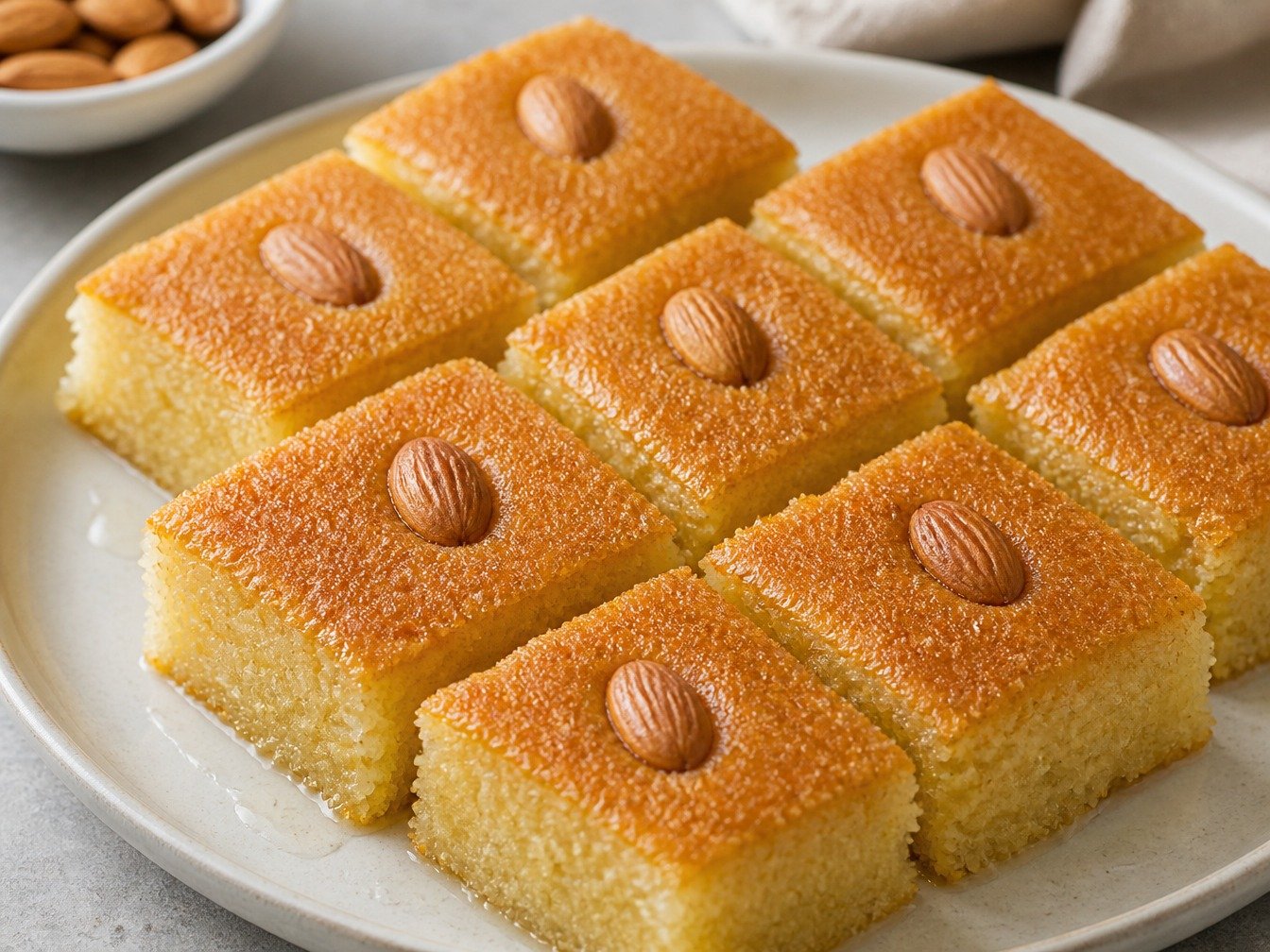
Country of origin: Egypt (with widely claimed variations across the Levant, Turkey, and beyond)
Today’s random pick lands on basbousa — a dense, syrup-soaked semolina cake, often layered with a bit of coconut or yogurt and finished with a whole almond or pistachio pressed into each piece before baking. It’s one of the most widely eaten sweets across the Arab world, and one of the clearest examples of how far a single dessert concept can travel and mutate while still being recognizably the same basic idea.
An Egyptian Sweet That Spread Under Many Names
Basbousa is generally considered Egyptian in origin, with the name itself believed to derive from a colloquial Egyptian Arabic term. From Egypt, the dessert spread widely across the region, and in doing so, picked up an unusually large number of regional names for what is fundamentally the same style of syrup-soaked semolina cake. In much of the Levant, particularly Lebanon and Syria, the same dessert is commonly called namoura or harissa (unrelated to the North African chili paste of the same name, in yet another regional naming overlap common across this cuisine). In Turkey, a closely related version is known as revani, typically made with a lighter, more sponge-like texture. Greek and Balkan cuisines have their own versions as well, often called ravani, reflecting the same Ottoman-era culinary exchange that carried so many other dishes across the empire’s former territory.
This pattern — one dessert concept, a dozen regional names, each community treating their version as distinctly their own — shows up repeatedly across Middle Eastern and Eastern Mediterranean food history, and basbousa is one of the clearer examples of it, precisely because the core technique stays so recognizable across each version even as the name and small details shift.
Semolina, Not Flour, Is the Defining Choice
What separates basbousa from other syrup-soaked cakes in the region, like Western-style syrup cakes, is its base ingredient: semolina, a coarser, more granular flour milled from durum wheat, rather than standard fine wheat flour. Semolina gives basbousa a distinctly grainy, slightly dense texture, quite different from the fine, soft crumb you’d get from all-purpose flour, and it also absorbs syrup differently — holding onto more liquid without turning to mush, which is part of why basbousa can handle such a generous syrup soak without collapsing into sogginess the way a more delicate flour-based cake might.
The Syrup Timing Rule (Again)
As with baklava and knafeh, basbousa follows the same general principle common across syrup-soaked Middle Eastern desserts: temperature contrast matters. Hot basbousa should be soaked with room-temperature or cold syrup, allowing the cake to absorb the syrup gradually and evenly as it cools, rather than becoming instantly waterlogged. Pouring hot syrup onto a hot cake tends to overwhelm the texture and can make the final result gummy rather than pleasantly moist.
The Recipe
Makes about 20 pieces
Ingredients
For the cake:
- 2 cups fine semolina
- 1 cup plain yogurt
- ½ cup sugar
- ½ cup unsalted butter, melted
- 1 teaspoon baking powder
- ½ teaspoon baking soda
- ½ cup shredded coconut (optional)
- Whole almonds or pistachios, for topping
For the syrup:
- 1 cup sugar
- ¾ cup water
- 1 tablespoon lemon juice
- 1 teaspoon rosewater or orange blossom water (optional)
Instructions
- Make the syrup first. Combine sugar, water, and lemon juice in a small saucepan and bring to a boil. Reduce heat and simmer for about 8 minutes until slightly thickened. Stir in rosewater or orange blossom water if using. Let cool completely before using.
- Mix the batter. In a large bowl, combine semolina, yogurt, sugar, melted butter, baking powder, baking soda, and coconut if using. Stir until well combined into a thick, slightly grainy batter. Let it rest for about 15 minutes, which helps the semolina hydrate a bit before baking.
- Prepare the pan. Pour the batter into a greased baking dish, spreading it evenly and smoothing the top.
- Score and top. Using a knife, score the batter into diamond or square shapes before baking, cutting partway through (this makes cutting cleanly after baking much easier). Press a whole almond or pistachio into the center of each scored piece.
- Bake. Bake at 350°F (175°C) for 30–35 minutes, until deeply golden on top and set throughout.
- Syrup while hot. As soon as the basbousa comes out of the oven, immediately pour the cooled syrup evenly over the top, letting it soak into the scored lines and edges.
- Rest before serving. Let the basbousa sit for at least 30 minutes, or longer, so the syrup fully absorbs before cutting along the scored lines and serving.
A Note on Texture
If the basbousa seems too dense straight out of the oven, that’s expected — semolina cakes are meant to have a denser, more substantial texture than a typical Western sponge cake, and the syrup soak further softens and moistens the texture as it rests.
Serving Suggestions
Basbousa is often served alongside coffee or tea, cut into small pieces given how rich and sweet it is, and works well as part of a larger dessert spread alongside baklava or knafeh.
Basbousa’s many regional names tell the same story as so many dishes in this region — a single good idea, carried across borders, becoming a little different and a little more beloved in each new kitchen it landed in.