
Baklava: The Dessert Claimed by an Entire Empire’s Worth of Kitchens

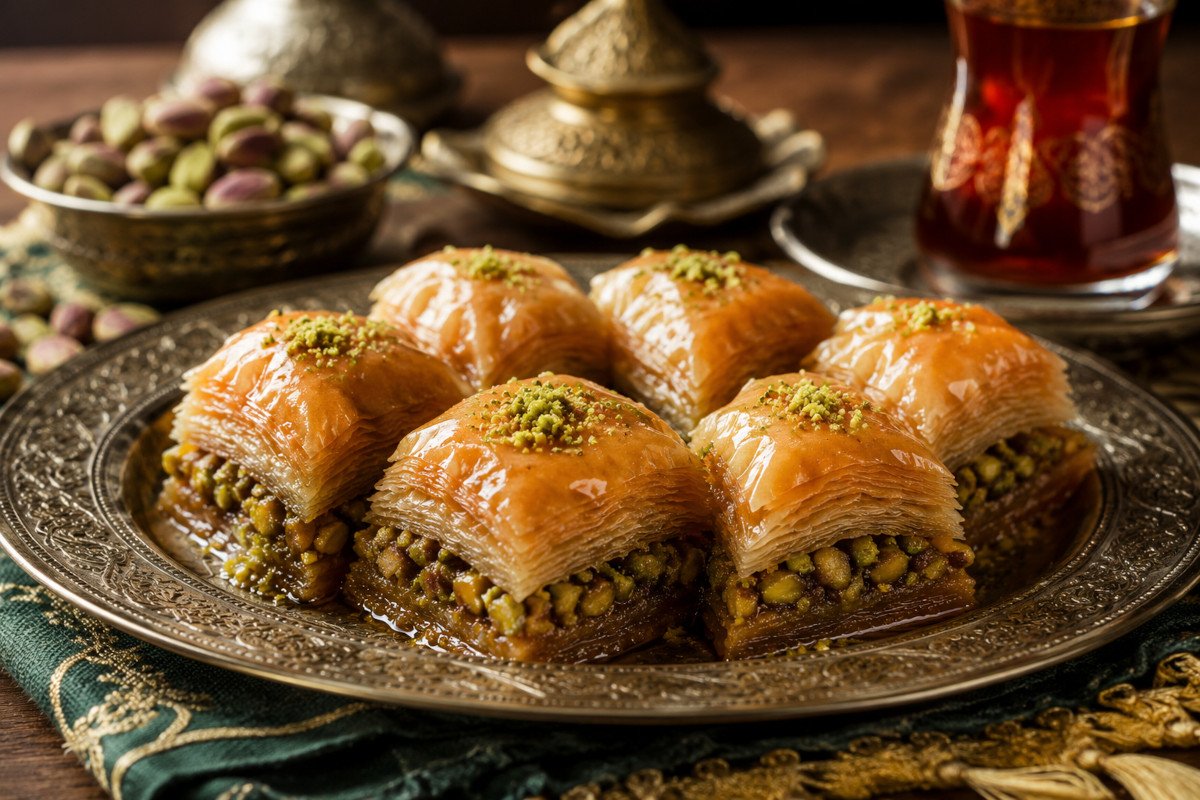
Layers of paper-thin phyllo pastry, brushed with butter, filled with chopped nuts, and soaked in sweet syrup or honey. Few desserts inspire as much cross-cultural pride and debate as this one, with Turkey, Greece, and several countries across the former Ottoman Empire and the Levant all claiming some form of ownership over its true origin.
An Origin Story That Spans Centuries and Empires
Baklava’s history is genuinely difficult to trace to a single point of origin, and that difficulty is itself part of the story. Food historians generally agree the dish, or something close to it, existed in some form in the ancient world — layered pastries sweetened with honey appear in Assyrian and later Byzantine culinary traditions — but the version most people recognize today as baklava took shape and spread widely during the Ottoman Empire, where it became strongly associated with the imperial kitchens of Topkapi Palace in Istanbul. From there, as the Ottoman Empire’s territory stretched across the Balkans, the Levant, North Africa, and parts of the Arabian Peninsula, baklava traveled with it, adapting to local ingredients and tastes in each region it reached.
This is why so many countries today have a legitimate historical claim to some version of baklava — Greek, Turkish, Lebanese, Armenian, and various Balkan versions all developed distinct regional identities, using different nut fillings, spicing, and syrup styles, while sharing the same fundamental layered-phyllo structure. Rather than a dish with one true origin being disputed, baklava is better understood as a shared culinary inheritance that many cultures across a former empire each shaped in their own way.
Regional Differences That Actually Matter
The differences between regional baklava styles aren’t superficial. Turkish baklava commonly uses pistachios, particularly in the Gaziantep region of southeastern Turkey, considered by many the baklava capital of the country, and tends to use a lighter sugar syrup rather than honey. Greek baklava often leans on walnuts and cinnamon, with honey playing a more prominent role in the syrup. Levantine baklava frequently incorporates orange blossom or rosewater into the syrup, along with pistachios or a walnut-pistachio mix, giving it a distinctly floral, aromatic quality that’s less common in Greek or Turkish versions. None of these differences are minor — they meaningfully change the final flavor profile of the dessert, even though the basic technique of layering thin pastry with nuts and syrup stays consistent.
The Two Things That Make or Break Baklava
Getting good baklava right comes down to two technical details. First, the phyllo needs to be worked with quickly and kept covered with a damp towel while assembling, since the sheets dry out and become brittle within minutes of exposure to air — a rushed or careless assembly process is one of the most common reasons homemade baklava turns out uneven or cracked. Second, and just as important, is the temperature contrast between the pastry and the syrup: hot baklava should always be soaked with cold (or room temperature) syrup, and cold baklava with hot syrup. Pouring hot syrup over hot pastry, or cold syrup over cold pastry, tends to produce a soggy result rather than the crisp-yet-syrup-soaked texture that defines properly made baklava.
The Recipe
Makes about 24 pieces
Ingredients
For the filling:
- 3 cups walnuts or pistachios (or a mix), finely chopped
- 1 teaspoon ground cinnamon
- 2 tablespoons sugar
For the pastry:
- 1 lb phyllo dough, thawed
- 1 cup unsalted butter, melted
For the syrup:
- 1 cup sugar
- ¾ cup water
- ¼ cup honey
- 1 tablespoon lemon juice
- 1 teaspoon rosewater or orange blossom water (optional)
Instructions
- Make the syrup first. Combine sugar, water, and honey in a saucepan and bring to a boil. Reduce heat and simmer for about 10 minutes until slightly thickened. Stir in lemon juice and rosewater or orange blossom water if using. Let cool completely — the syrup needs to be at room temperature or cold before it meets the hot baked baklava.
- Prepare the filling. Mix the chopped nuts with cinnamon and sugar in a bowl.
- Layer the base. Brush a baking dish with melted butter. Layer about 8–10 sheets of phyllo in the bottom, brushing each individual sheet with melted butter before adding the next, keeping unused phyllo covered with a damp towel throughout.
- Add the filling. Spread about half of the nut mixture evenly over the layered phyllo base.
- Continue layering. Add another 6–8 buttered phyllo sheets over the nuts, then spread the remaining nut mixture over that layer.
- Finish the top. Layer the remaining phyllo sheets on top, brushing each with butter, finishing with a final generous brush of butter on the very top sheet.
- Cut before baking. Using a sharp knife, cut the assembled baklava into diamond or square shapes, cutting all the way through to the bottom of the pan. This is much easier to do cleanly before baking than after.
- Bake. Bake at 350°F (175°C) for 40–45 minutes, until deeply golden and crisp throughout.
- Syrup while hot. As soon as the baklava comes out of the oven, immediately pour the cooled syrup evenly over the top, making sure it reaches into the cuts. Let it sit for at least a few hours, or ideally overnight, so the syrup fully absorbs.
A Note on Working With Phyllo
If a few sheets tear while layering, don’t worry — since baklava is built from many stacked layers, small tears in one or two sheets won’t be noticeable in the final result, and patching a torn sheet with a scrap piece works fine.
Serving Suggestions
Baklava is traditionally served in small pieces, often alongside Turkish or Arabic coffee, since its sweetness is quite concentrated and pairs well with a strong, unsweetened drink to balance it.
Baklava’s spread across an empire’s worth of kitchens is part of what makes it special — proof that some desserts become greater than any single country’s claim to them.