
Mahalabia: The Milk Pudding That’s Been on Middle Eastern Tables for Over a Thousand Years

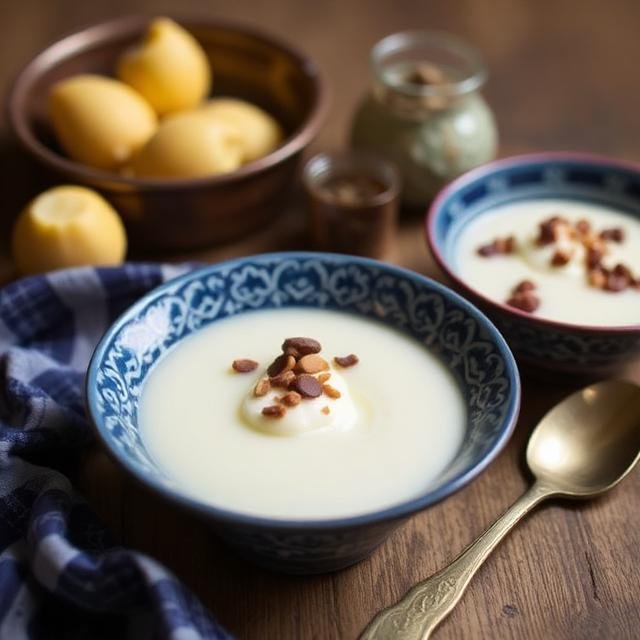
Country of origin: Widely shared across the Levant, Egypt, and the Gulf, with roots reaching back to early Abbasid-era cooking
This round’s pick is mahalabia (also spelled muhallabia or muhallebi in Turkish) — a delicate, lightly sweetened milk pudding thickened with cornstarch or rice flour, typically flavored with rosewater or orange blossom water and topped with crushed pistachios. It’s one of the oldest continuously documented desserts in the region’s culinary history, with a name that’s believed to trace directly back to a specific historical figure, similar to the naming pattern seen with dishes like İskender kebab.
A Dessert Possibly Named After a Historical Governor
The most commonly repeated account of mahalabia’s origin connects the dish’s name to al-Muhallab ibn Abi Sufra, a military commander and governor during the early Umayyad period, with the dish said to have been prepared for him or associated with his household, eventually taking on a version of his name. As with several other origin stories discussed on this blog, this account should be treated as a widely repeated tradition rather than airtight historical fact, but what’s better documented is that milk-based puddings thickened with rice or starch appear in Abbasid-era Arabic culinary texts from as early as the 9th and 10th centuries, placing mahalabia, or something very close to it, among the genuinely oldest specifically documented desserts still regularly made and eaten across the region today.
From those early roots, mahalabia spread widely across the Arab world, into Turkey (where it’s known as muhallebi and remains an extremely popular everyday dessert), and further into the Balkans and beyond, following patterns of culinary spread similar to those discussed in relation to baklava and basbousa elsewhere on this blog.
A Rare Case of a Simple, Purely Milk-Based Sweet
Compared to many of the other desserts covered on this blog, most of which rely heavily on nuts, phyllo pastry, or fried dough as their foundation, mahalabia stands out for being one of the simplest and most minimal in construction — essentially just milk, sugar, and a starch thickener, without any pastry, frying, or lengthy baking involved at all. This simplicity is part of what has likely helped it remain such a consistently popular, easy-to-make dessert across so many households and so many centuries, requiring far less specialized technique or equipment than something like knafeh or baklava, while still delivering a distinctly luxurious, silky texture when made properly.
Getting the Starch Ratio Right Is the Entire Skill
Since mahalabia has so few ingredients, the technique of properly cooking the starch and milk together becomes disproportionately important to the dish’s success. Too little starch relative to the amount of milk, and the pudding won’t set properly, staying loose and runny rather than achieving the soft, sliceable, custard-like consistency mahalabia is known for. Too much starch, and the texture turns gluey or overly stiff, losing the light, delicate quality that distinguishes a well-made mahalabia from a heavier, more starch-forward pudding. Cooking the mixture over gentle, consistent heat while stirring constantly is also essential, since starch-thickened milk mixtures can scorch on the bottom of the pot relatively easily if left unattended even briefly, which would introduce an unwanted burnt flavor throughout the entire batch.
The Recipe
Serves 4–6
Ingredients
- 4 cups whole milk
- ½ cup sugar
- 5 tablespoons cornstarch
- ¼ cup cold water
- 1 tablespoon rosewater or orange blossom water
- ¼ cup crushed pistachios, for garnish
- Ground cinnamon, for garnish (optional)
Instructions
- Dissolve the cornstarch. In a small bowl, whisk the cornstarch into the cold water until completely smooth, with no lumps. Set aside.
- Warm the milk. In a saucepan, combine the milk and sugar. Heat over medium heat, stirring occasionally, until the sugar dissolves and the milk is warm, but not boiling.
- Add the cornstarch mixture. Slowly whisk the cornstarch slurry into the warm milk, stirring constantly.
- Cook until thickened. Continue cooking over medium-low heat, stirring constantly and consistently, for about 8–10 minutes, until the mixture thickens noticeably and coats the back of a spoon. Be patient and keep stirring throughout, since this mixture can scorch quickly if left unattended, even for a short moment.
- Add flavoring. Remove from heat and stir in the rosewater or orange blossom water.
- Set the pudding. Pour the mixture into individual serving bowls or a larger dish. Let cool at room temperature, then refrigerate for at least 2–3 hours, or until fully set and chilled.
- Garnish and serve. Top with crushed pistachios and a light dusting of cinnamon if using, just before serving.
A Note on Texture Troubleshooting
If your mahalabia turns out too thin after chilling, it likely needed a bit more cooking time on the stove to fully activate the cornstarch’s thickening properties — next time, extend the cooking time slightly, watching for the mixture to visibly thicken and coat a spoon before removing it from the heat.
Serving Suggestions
Mahalabia is traditionally served chilled, in small individual portions, and works well as a light, refreshing dessert after a heavier meal, given how much less rich it is compared to many of the more nut- and syrup-heavy sweets covered elsewhere on this blog.
Mahalabia’s simplicity is deceptive — a dessert with barely three core ingredients that’s managed to stay a beloved staple across the region for well over a thousand years.