
Musakha – Inside Palestine’s National Dish

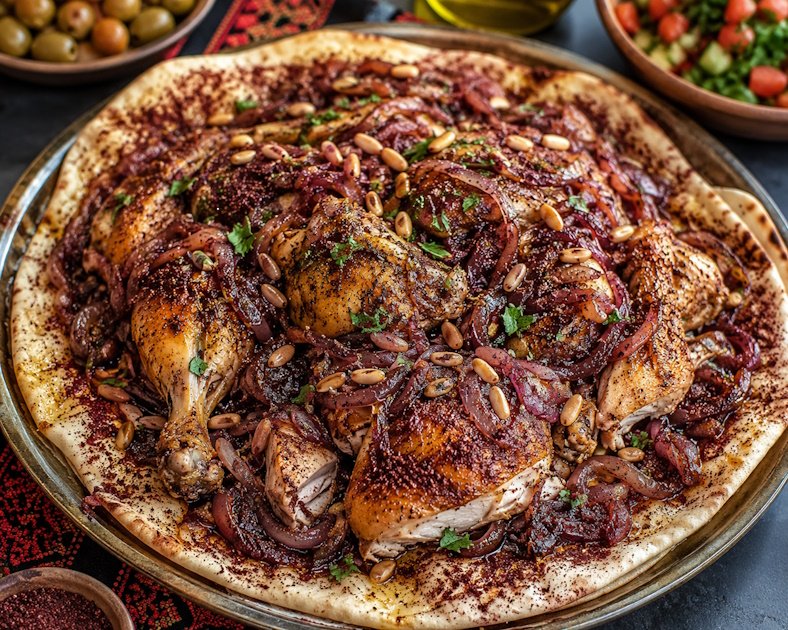
Some dishes are best understood not just as a list of ingredients, but as a record of a place, a season, and a people. Musakhan is one of those dishes. At its simplest, it’s roasted chicken piled onto flatbread soaked in olive oil and dusted with sumac. But look closer, and musakhan is really a story about the Palestinian olive harvest, centuries of trade in a single tart red spice, and a style of cooking built around bread as both plate and ingredient.
Where It Comes From
Musakhan (sometimes spelled musakhkhan) is widely considered the national dish of Palestine, most closely associated with the villages around Nablus, Jenin, and the northern West Bank. Its name comes from the Arabic root sakhuna, meaning “to warm” or “to heat” — a reference to how the dish is traditionally served hot, straight from the oven, with the bread still soft from soaking up the drippings underneath the chicken.
Historically, musakhan was closely tied to the olive harvest season in October and November. Families would gather to pick olives, and the dish became a way of celebrating the season’s first pressing of fresh olive oil — the greenest, most peppery oil of the year, used generously and without restraint. Even today, many Palestinian families still consider musakhan an autumn dish, best made when the new oil arrives.
The Spice That Defines the Dish
If olive oil is musakhan’s backbone, sumac is its soul. Made from the dried, ground berries of the sumac shrub (Rhus coriaria), this spice has a tart, almost lemony sharpness that’s completely different from anything else in the regional pantry. It’s been used across the Levant, Turkey, and Iran for thousands of years — the Romans reportedly used it as a souring agent before lemons became widely available in the Mediterranean.
In musakhan, sumac isn’t a light garnish — it’s mixed generously with the sautéed onions and rubbed into the chicken itself, turning both a deep brick-red. The tartness cuts through the richness of the olive oil and roasted chicken fat, which is part of why the dish feels balanced rather than heavy, despite how much oil goes into it.
The Bread Matters As Much As the Chicken
Traditionally, musakhan is built on taboon bread — a rustic, slightly chewy flatbread baked in a taboon, a clay oven lined with river stones, which gives the bread its name and its characteristic dimpled surface. The bread isn’t just a vessel; it’s meant to absorb the chicken drippings, oil, and spiced onions underneath, so that by the time you eat it, the bread itself is arguably the best part of the dish. If you can’t get taboon bread, a good substitute is a thick, sturdy flatbread like a large pita split open, or even a rustic sourdough that can hold up to being soaked without falling apart.
The Recipe
Serves 4–6
Ingredients
For the chicken:
- 1 whole chicken, cut into 8 pieces (or 6–8 bone-in, skin-on thighs)
- ¼ cup olive oil
- 1 teaspoon salt
- ½ teaspoon black pepper
- ½ teaspoon ground cumin
For the sumac onions:
- ½ cup olive oil (Palestinian, if you can find it — fresh-pressed and green)
- 4 large yellow onions, thinly sliced
- 4 tablespoons ground sumac, plus more for garnish
- 1 teaspoon salt
- ½ teaspoon allspice
- ¼ teaspoon cinnamon
To assemble:
- 3–4 pieces taboon bread, or large sturdy flatbread/pita
- ¼ cup pine nuts, toasted in a little olive oil until golden
- Fresh lemon wedges, for serving
Instructions
- Season the chicken. Rub the chicken pieces with olive oil, salt, pepper, and cumin. Let sit for at least 20 minutes, or up to overnight in the fridge for deeper flavor.
- Cook down the onions. In a large, wide pan, heat the olive oil over medium-low heat. Add the sliced onions and cook slowly, stirring occasionally, for about 30 minutes, until deeply soft and just beginning to turn golden — you’re not aiming for the crisp caramelization of French onion soup, but a soft, jammy texture. Stir in the sumac, salt, allspice, and cinnamon, and cook for another 2–3 minutes until fragrant. Set aside about a third of the onions for garnish.
- Roast the chicken. Preheat your oven to 425°F (220°C). Arrange the chicken pieces skin-side up on a roasting tray and roast for 35–40 minutes, until the skin is golden and the chicken is cooked through. For extra color, you can finish under the broiler for 2–3 minutes at the end.
- Build the base. Lightly warm the taboon bread or flatbread. Spread a generous layer of the sumac onions over the bread, letting some of the oil soak in.
- Assemble and finish. Arrange the roasted chicken pieces on top of the onion-covered bread. Spoon over any remaining pan juices, scatter with the reserved sumac onions, and top with toasted pine nuts.
- Serve. Serve hot, directly from the tray if you can, with lemon wedges on the side. Musakhan is traditionally eaten with the hands — tear off a piece of bread with chicken and onions together in each bite.
A Note on Getting It Right
The most common mistake with musakhan is being stingy with the olive oil — this is a dish where the fat is the point, carrying both flavor and the sumac’s tartness into every layer. Palestinian home cooks often say the bread should almost be too oily to pick up cleanly; that’s when you know it’s done right.
Serving Suggestions
Musakhan is usually served as a main dish with little else needed — perhaps a simple side of plain yogurt or a sharp, vinegary salad to cut through the richness. It’s a dish meant for a shared table, torn apart by hand, not portioned onto individual plates.
Musakhan is less a recipe than an inheritance — a dish shaped by olive groves, harvest seasons, and generations of families gathering around the same tray.