
Sfiha: The Open-Faced Meat Pie of the Levant

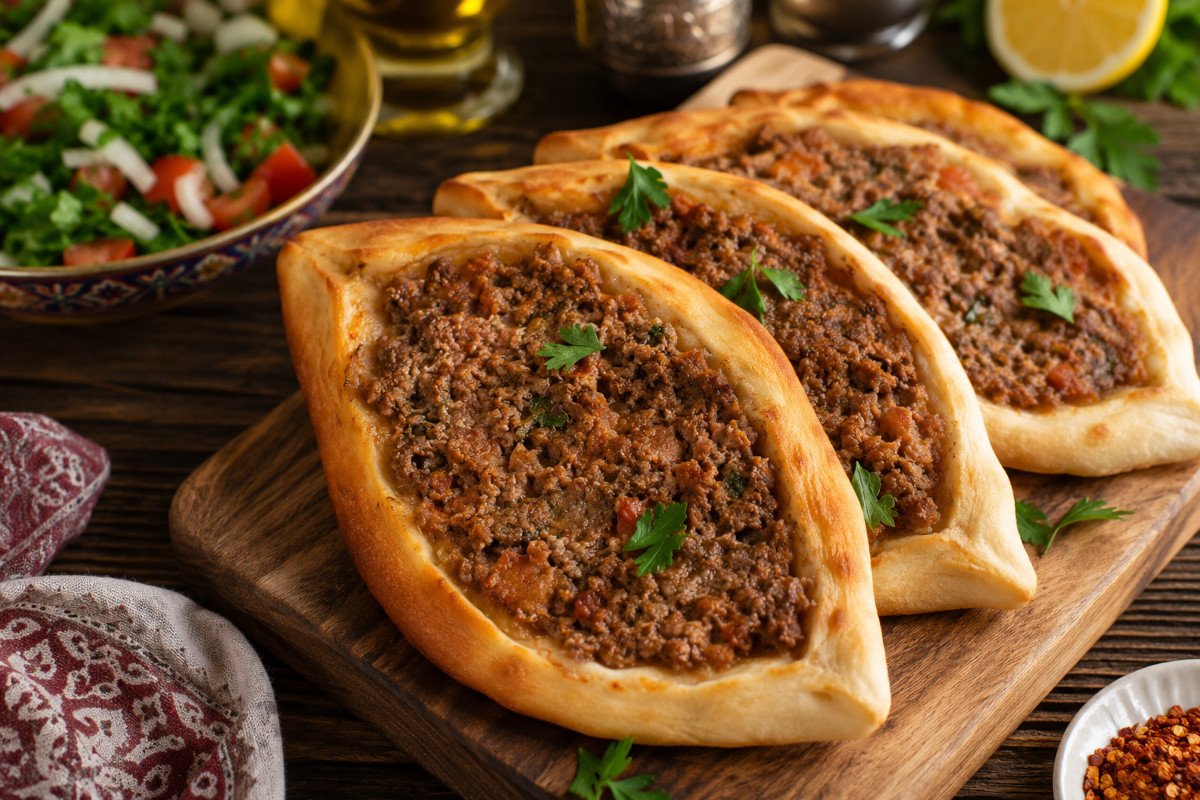
Country of origin: Levant (Syria and Lebanon in particular)
Today’s random pick lands on sfiha (also spelled sfeeha or sfiha, and sometimes referred to as Lebanese or Syrian meat pies) — small, open-faced pastries topped with a mixture of spiced ground meat, tomato, and pomegranate molasses, baked until the edges turn golden and the topping sets into a savory, slightly tangy layer. It’s a dish closely related to Turkey’s lahmacun, and the resemblance isn’t a coincidence — both trace back to a shared Ottoman-era culinary lineage of thin, meat-topped flatbreads, even though each developed its own distinct regional identity over time.
A Regional Cousin of Lahmacun, Shaped by Local Taste
Sfiha and lahmacun share an obvious family resemblance: both are thin rounds of dough topped with a mixture of ground meat, vegetables, and spices, then baked at high heat until crisp at the edges. This shared structure reflects the broader Ottoman-era spread of thin, meat-topped flatbread traditions across Anatolia and the Levant, similar to how manti and other dishes moved and adapted across the empire’s former territory. What sets Aleppo-style sfiha apart from Turkish lahmacun most distinctly is the inclusion of pomegranate molasses in the meat topping, giving it a tangier, slightly sweet-and-sour depth that lahmacun’s typically more straightforward, tomato-and-pepper-forward topping doesn’t have. Sfiha is also generally made with a thicker, more bread-like dough than the very thin, cracker-like base traditional to lahmacun.
Aleppo, in particular, is closely associated with a well-regarded version of sfiha, consistent with the city’s broader reputation, discussed elsewhere on this blog in relation to muhammara, as one of the most historically refined culinary centers in the Levant and the wider Ottoman world.
Why Pomegranate Molasses Changes Everything
The inclusion of pomegranate molasses in the meat topping is really the detail that gives Syrian and Lebanese sfiha its specific regional character, distinguishing it from other, similar meat-topped flatbreads found elsewhere in the region. Its tart, syrupy sourness cuts through the richness of the spiced meat and adds a distinctly Levantine flavor signature, the same ingredient that plays a defining role in muhammara and shows up throughout Syrian and Lebanese cooking more broadly as a go-to way of adding brightness and acidity without relying on lemon juice alone.
An Open Structure With a Practical Purpose
Unlike a fully enclosed meat pie or pastry, sfiha’s open-faced design serves a clear practical function: since the meat topping is exposed directly to the oven’s heat, it cooks quickly alongside the dough, browning and slightly caramelizing at the edges in the same short baking window it takes for the dough itself to crisp. A fully enclosed pie would require either a longer bake time to cook the filling through, or a filling that’s fully pre-cooked before assembly — the open design lets both components finish together efficiently, which likely contributed to its practicality as an everyday, quickly prepared food rather than a more elaborate, occasion-only dish.
The Recipe
Makes about 16 pieces
Ingredients
For the dough:
- 3 cups all-purpose flour
- 1 teaspoon instant yeast
- 1 teaspoon sugar
- 1 teaspoon salt
- 2 tablespoons olive oil
- 1 cup warm water (approximate, as needed)
For the topping:
- 1 lb ground lamb or beef
- 1 small onion, finely chopped or grated
- 2 medium tomatoes, finely diced
- 2 tablespoons pomegranate molasses
- 1 tablespoon tomato paste
- 2 tablespoons olive oil
- ½ teaspoon ground allspice
- ¼ teaspoon cinnamon
- ¼ teaspoon chili flakes or a pinch of cayenne (optional)
- Salt and black pepper, to taste
- 2 tablespoons pine nuts (optional)
Instructions
- Make the dough. Combine flour, yeast, sugar, and salt in a large bowl. Add olive oil and gradually mix in warm water, kneading for 8–10 minutes until smooth and elastic. Cover and let rise in a warm place for about 1 hour, until roughly doubled.
- Make the topping. In a bowl, combine the ground meat, onion, diced tomato, pomegranate molasses, tomato paste, olive oil, allspice, cinnamon, chili flakes if using, salt, and pepper. Mix thoroughly until well combined into a spreadable, slightly loose mixture.
- Divide the dough. Punch down the risen dough and divide into 16 small balls. Roll or press each into a thin round, about 4 inches wide.
- Top the dough. Spread a generous, even layer of the meat topping over each round, leaving a small border around the edge. Scatter a few pine nuts over each piece, if using.
- Bake. Arrange the topped rounds on baking sheets and bake at 475°F (245°C) for 10–12 minutes, until the edges of the dough are golden and the meat topping is fully cooked and slightly caramelized in spots.
- Serve. Serve warm, ideally shortly after baking.
A Note on the Meat Topping
Keep the meat mixture on the loose, slightly wet side rather than very dry — since it cooks directly in the hot oven without any pre-cooking, a slightly looser mixture helps it cook through evenly in the short bake time without drying out.
Serving Suggestions
Sfiha is often eaten folded in half, sometimes with a squeeze of fresh lemon on top just before eating, and works well as a light meal, a starter, or part of a larger mezze spread.
Sfiha shows how a single Ottoman-era flatbread concept can travel a short geographic distance and still come out meaningfully different — proof that a single defining ingredient, in this case pomegranate molasses, can be enough to give a dish its own regional identity.