
Manakish: The Levantine Flatbread Built Around a Single Spice Blend

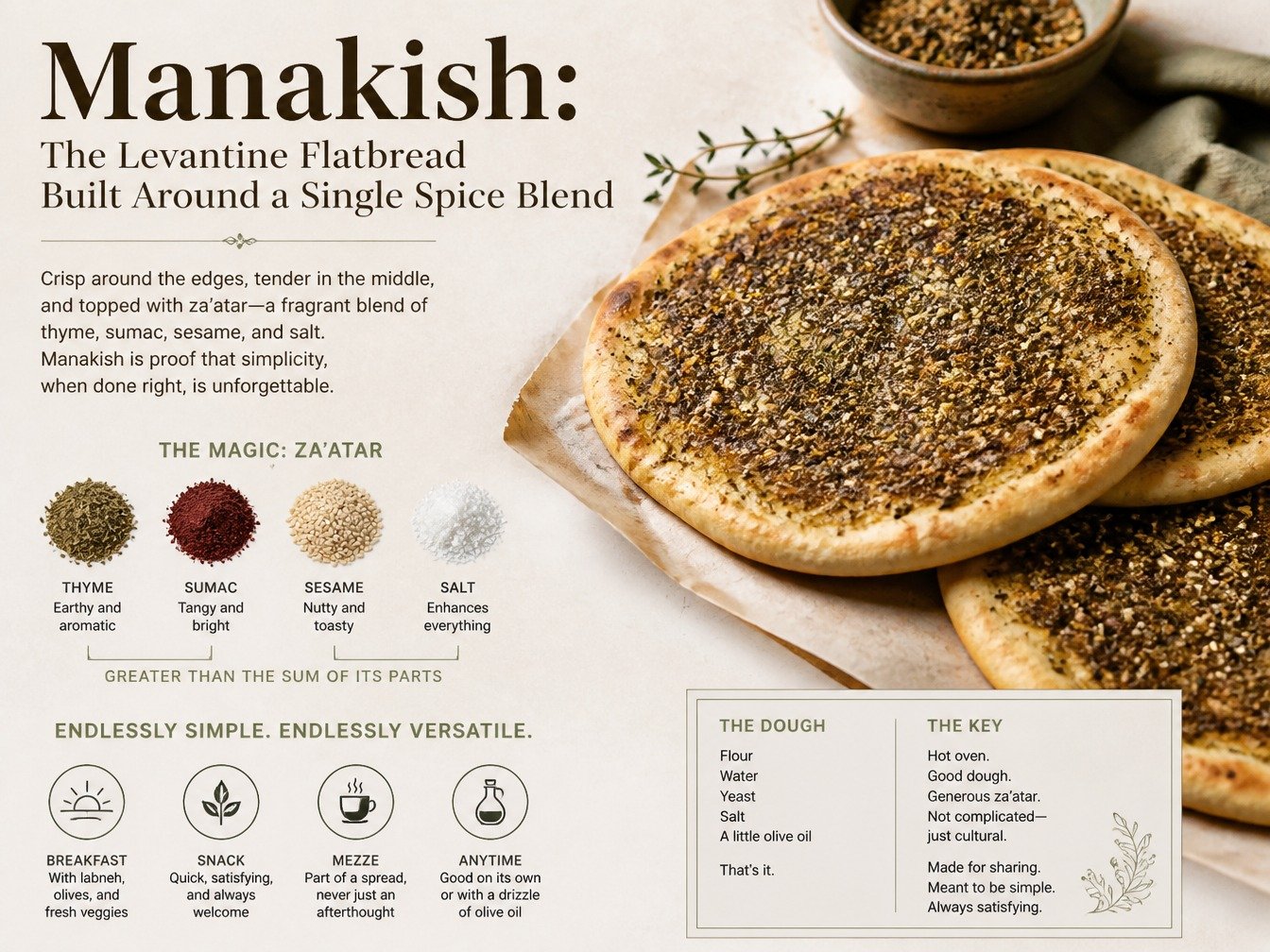
Manakish (singular: manoushe) — a flatbread topped most classically with za’atar and olive oil, baked until the edges turn golden and the topping toasts into a fragrant, slightly crisp layer. It’s one of the most everyday dishes in Levantine cooking, eaten constantly for breakfast across Lebanon, Syria, Jordan, and Palestine, and its identity is inseparable from the spice blend that defines it.
Za’atar: A Spice Blend and a Plant, Confusingly Named the Same Thing
Understanding manakish requires understanding za’atar, which refers to two related but distinct things: a specific herb (a wild thyme-like plant native to the Levant, related to but distinct from common thyme) and, more commonly today, a spice blend built around that herb, typically combining dried za’atar (or a mix of thyme, oregano, and marjoram as substitutes), toasted sesame seeds, sumac, and salt. The blend’s exact recipe varies significantly by family, region, and country — Lebanese, Palestinian, Syrian, and Jordanian versions of za’atar all differ somewhat in ratio and sometimes in additional ingredients, and many households consider their specific blend a point of pride, sometimes closely guarded and passed down through generations.
Za’atar the plant itself has deep roots in the region, with references to it appearing in historical texts stretching back well over a thousand years, and it’s long been valued not just as a flavoring but as a plant associated with health and vitality in traditional regional practices, even functioning symbolically in some communities as an emblem of connection to the land, particularly among Palestinians, for whom foraging and harvesting wild za’atar carries significant cultural weight.
Why Manakish Became a Breakfast Staple
Manakish’s rise as an everyday breakfast food is closely tied to the practicalities of Levantine bakery culture. Neighborhood bakeries across the region often bake manakish fresh each morning, using the same hot ovens that produce the day’s bread, making it a convenient, freshly baked, inexpensive option that people pick up on their way to work or school rather than something typically made from scratch at home each day. This bakery-centered tradition is part of why manakish carries a distinct “grab-and-go” identity in Levantine food culture, closer in spirit to how a croissant or bagel functions in other food traditions, even though it’s entirely possible, and increasingly common, to make it at home.
Beyond Za’atar: Other Common Toppings
While za’atar is the most iconic and traditional topping, manakish dough is genuinely versatile, and bakeries typically offer a range of options. Cheese manakish, usually made with a stretchy white cheese similar to akkawi or a mozzarella blend, is extremely popular. Manakish bi lahme, topped with a thin layer of spiced ground meat similar to a simplified lahm bi ajeen, is another common variation. Some bakeries also offer a combination version, split between za’atar and cheese on the same piece of dough, letting people get both flavors without having to choose.
The Recipe
Makes 6–8 manakish
Ingredients
For the dough:
- 3 cups all-purpose flour
- 1 teaspoon instant yeast
- 1 teaspoon sugar
- 1 teaspoon salt
- 2 tablespoons olive oil
- 1 cup warm water (approximate, as needed)
For the za’atar topping:
- ½ cup za’atar spice blend (store-bought, or a mix of dried thyme, oregano, toasted sesame seeds, sumac, and salt)
- ⅓ cup olive oil
Instructions
- Make the dough. In a large bowl, combine flour, yeast, sugar, and salt. Add olive oil and gradually mix in warm water, kneading for about 8–10 minutes until you get a smooth, elastic dough. Cover and let rise in a warm place for about 1 hour, until roughly doubled in size.
- Divide the dough. Punch down the risen dough and divide it into 6–8 equal balls. Cover and let rest for another 10–15 minutes, which makes the dough easier to shape.
- Shape the bases. On a lightly floured surface, roll or stretch each ball into a round, roughly 6–7 inches wide and about ¼ inch thick. Transfer to a baking sheet lined with parchment paper.
- Make the topping. In a small bowl, mix the za’atar spice blend with olive oil until it forms a thick, spreadable paste.
- Top the dough. Spread a generous, even layer of the za’atar-oil mixture over each round of dough, leaving a small border around the edge.
- Bake. Bake at 475°F (245°C) for 8–10 minutes, until the edges are golden and the dough is fully cooked through, keeping an eye on it since the high heat means it can go from perfectly baked to overdone fairly quickly.
- Serve. Serve warm, ideally fresh from the oven while the topping is still fragrant and the edges are crisp.
A Note on Za’atar Quality
The quality of your za’atar blend makes a real difference here, since it’s essentially the entire flavor of the dish. If possible, seek out a good-quality, ideally Levantine-sourced za’atar blend rather than a generic supermarket version, since the balance of herbs, sumac, and sesame varies enormously between brands and can meaningfully change the final result.
Serving Suggestions
Manakish is traditionally eaten folded in half or rolled up, often with a few fresh additions tucked inside — sliced tomato, cucumber, mint, or a bit of labneh are all common, turning the flatbread into something closer to a wrap.
Manakish shows how a single well-made spice blend can define an entire everyday food tradition — proof that sometimes the simplest dishes are the ones eaten most often for a reason.