
Mulukhiyah: The “Royal” Stew With Roots in Ancient Egypt

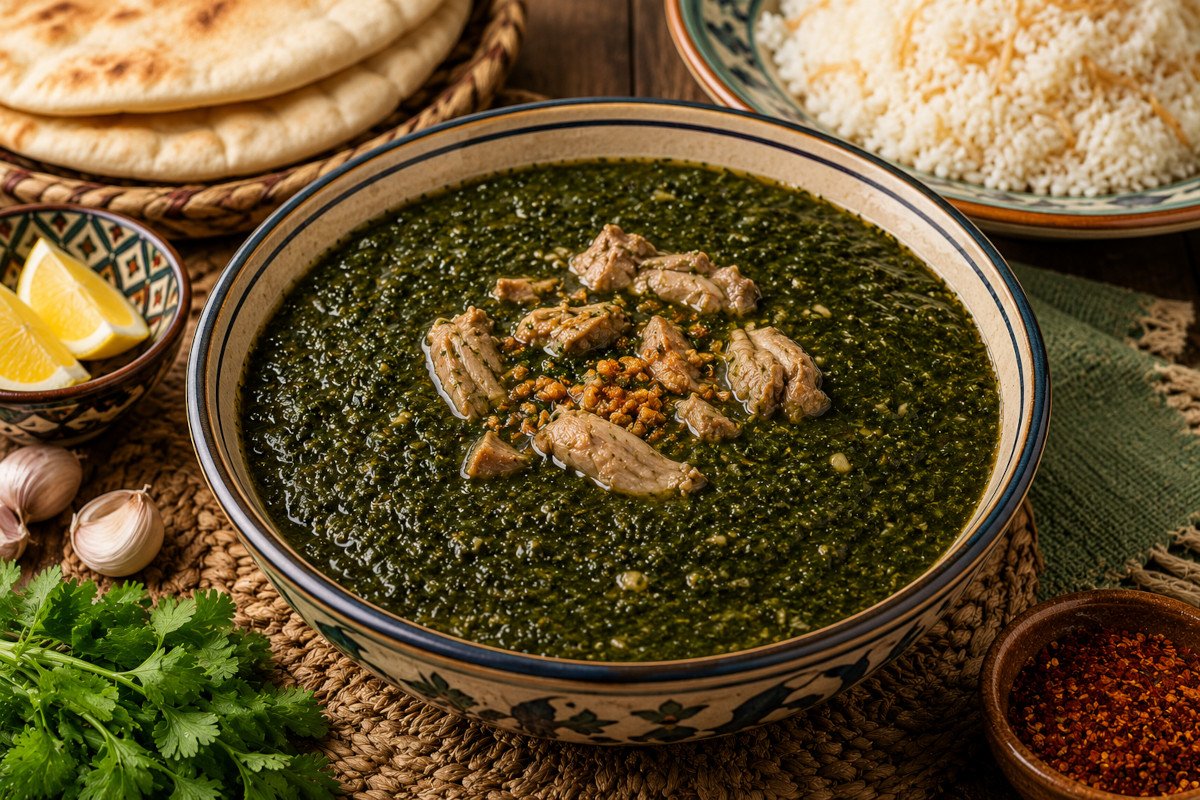
Today’s random pick lands back on Egyptian cuisine with mulukhiyah (also spelled molokhia or mloukhiya) — a deep green, slightly slippery stew made from the leaves of the jute plant, cooked down with garlic and coriander into a dish unlike almost anything else in Middle Eastern cooking, both in texture and in how far back its history reaches.
A Name That Means “Royal”
The word mulukhiyah is widely believed to derive from the Arabic root related to “malik,” meaning king or royal, and several popular explanations for this connection circulate. One common story holds that the dish was once restricted to or especially favored by Egyptian royalty and the wealthy, giving it an association with luxury and status before it eventually became a widespread, everyday staple across Egyptian households of all backgrounds. While the exact historical accuracy of that specific story is difficult to verify, what’s well documented is that jute leaves have been consumed in Egypt since antiquity, with some food historians tracing the plant’s culinary use back to Pharaonic Egypt, making mulukhiyah one of the longest continuously eaten dishes in the region’s food history.
Today, mulukhiyah is eaten across Egypt, the Levant, and parts of North Africa and West Africa, with each region developing its own version — Egyptian mulukhiyah is typically finely chopped and made into a thick, almost soup-like stew, while some Levantine versions keep the leaves whole and pair the dish with lamb rather than the chicken or rabbit more traditional in Egypt.
An Unusual, Divisive Texture
Mulukhiyah’s defining characteristic — and the thing that tends to surprise people trying it for the first time — is its texture. Jute leaves, once cooked, release a natural mucilage that gives the finished stew a distinctly slippery, almost viscous quality, not unlike okra, which shares a similar mucilaginous property. This texture is genuinely divisive: for people who grew up eating it, it’s a comforting, expected part of the dish; for newcomers, it can take some adjustment. Various techniques exist to manage the sliminess to taste, including adjusting how finely the leaves are chopped and how long the dish is cooked, since overcooking tends to intensify the mucilage while properly timed cooking keeps it more moderate.
Garlic and Coriander: The Flavor Base
While the leaves provide the body and texture, the flavor of mulukhiyah comes largely from a fried garlic-and-coriander mixture called a taqliya, added toward the end of cooking. Fresh garlic and ground coriander are fried briefly in ghee or oil until deeply fragrant, then stirred into the stew, providing a sharp, aromatic contrast to the mild, earthy jute leaves. This step is considered essential — a properly made mulukhiyah should have a noticeable garlic punch, and skipping or rushing this step is one of the most common ways the dish falls flat.
The Recipe
Serves 4–6
Ingredients
For the stew:
- 1 lb fresh mulukhiyah leaves (jute leaves), finely chopped, or 12 oz frozen chopped mulukhiyah
- 4 cups chicken broth (homemade from bone-in chicken pieces, if possible)
- 2 bone-in chicken thighs or a small whole chicken, cooked and shredded (reserve the broth)
- Salt, to taste
For the taqliya (garlic-coriander mixture):
- 3 tablespoons ghee or butter
- 6 cloves garlic, minced
- 1 tablespoon ground coriander
- ½ teaspoon ground cardamom (optional)
To serve:
- Cooked white rice
- Lemon wedges
- Sliced onion marinated in vinegar (optional, but traditional)
Instructions
- Cook the chicken and broth. If starting from scratch, simmer chicken thighs or a whole chicken in water with a little salt for about 45 minutes to 1 hour, until fully cooked and tender. Remove the chicken, shred the meat, and reserve the broth.
- Prepare the leaves. If using fresh mulukhiyah, wash the leaves thoroughly and chop them very finely — the finer the chop, the smoother and thicker the final stew. If using frozen chopped mulukhiyah, no additional prep is needed beyond thawing.
- Simmer the stew. Bring the reserved chicken broth to a boil in a large pot. Add the chopped mulukhiyah leaves and reduce to a simmer, cooking for about 15–20 minutes, stirring occasionally, until the leaves are fully softened and the stew has thickened slightly.
- Make the taqliya. In a small pan, melt the ghee over medium heat. Add the minced garlic and cook for about 1 minute, just until fragrant and lightly golden — be careful not to let it brown too much or turn bitter. Stir in the ground coriander and cardamom if using, cooking for another 30 seconds.
- Combine. Pour the hot taqliya directly into the simmering stew, stirring it in immediately so the garlic and spices distribute evenly. Add the shredded chicken back into the pot and season with salt to taste. Simmer for another 5 minutes to let the flavors meld.
- Serve. Ladle the stew over a bed of white rice. Serve with lemon wedges and vinegar-marinated onions on the side, both of which help cut through the richness and add brightness.
A Note on Managing the Texture
If the mucilaginous texture feels like too much on your first try, using a coarser chop rather than a very fine one, and keeping the simmer time on the shorter end, will result in a noticeably less slippery stew without losing the dish’s essential character.
Serving Suggestions
Mulukhiyah is traditionally served as a main course over rice, often alongside a piece of the chicken it was cooked with, though rabbit and beef versions are also common in different households and regions.
Mulukhiyah is a rare dish that connects a modern Egyptian dinner table directly back to antiquity — proof that some flavors and textures have simply never gone out of fashion.