
Ghormeh Sabzi: Iran’s Herb Stew and Unofficial National Dish

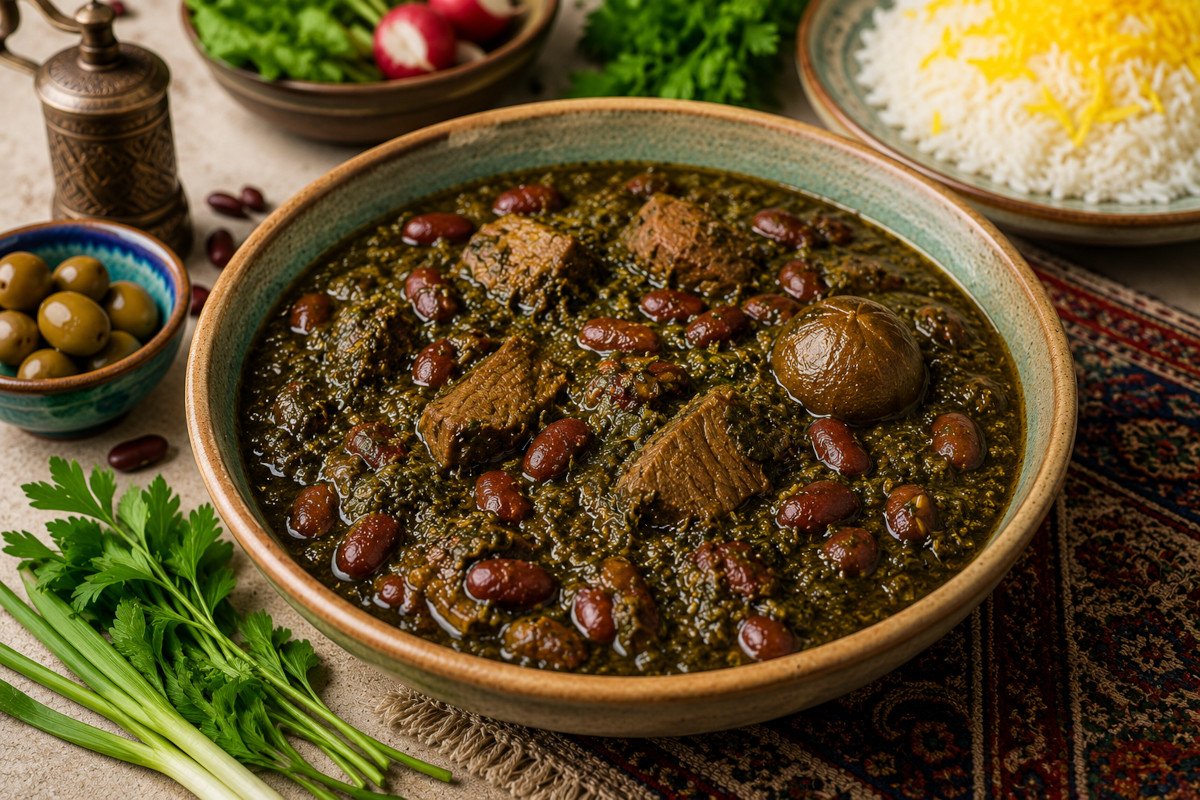
A deep green, tangy stew built almost entirely around a mountain of fresh herbs, slow-cooked with kidney beans, meat, and dried limes until everything melts into a thick, deeply savory sauce. If you ask many Iranians what their national dish is, ghormeh sabzi is one of the most common answers, and the sheer amount of herbs involved makes it one of the most distinctive stews anywhere in the region.
A Dish Named For Its Method, Not Its Ingredients
The name itself is a clue to what matters most about this dish. “Ghormeh” refers to a method of braising or sautéing meat, and “sabzi” simply means herbs or greens. Unlike many dishes named after a specific star ingredient, ghormeh sabzi is named after its technique and its defining category of ingredient — a signal that the herbs themselves, rather than any single one, are really the point.
Persian cooking has a particularly deep relationship with fresh herbs used in genuinely large quantities, not as a garnish but as a main component of a dish, and ghormeh sabzi represents perhaps the most extreme expression of that tradition. A proper batch typically calls for several loosely packed cups of a specific herb blend — usually parsley, cilantro, chives or green onion, and fenugreek leaves — meaning the herbs, by volume, often outweigh the meat in the pot.
Fenugreek: The Ingredient That Defines the Flavor
While parsley and cilantro make up the bulk of the herb mixture, fenugreek leaves are what give ghormeh sabzi its distinctive, slightly bitter, almost maple-like aromatic edge — a flavor unlike anything else commonly used in Middle Eastern cooking. Fresh fenugreek leaves aren’t always easy to find outside Iran and specialty Persian or South Asian grocers, so dried fenugreek leaves (kasuri methi) are a common and reasonably close substitute, used in smaller quantity since the dried form is more concentrated.
The herbs are traditionally sautéed on their own, separately from the meat, for a fairly long time before being added to the stew — a step that deepens their flavor considerably and removes some of the raw, grassy edge that fresh herbs can have in large quantity, transforming them into something richer and more savory.
Dried Limes: The Other Signature Note
The second defining ingredient is dried limes, called limoo amani — whole limes that have been boiled in salt water and then sun-dried until they turn dark and hollow, developing a distinctly tart, slightly smoky, almost fermented flavor completely different from fresh lime juice. In ghormeh sabzi, whole dried limes are added to the pot (sometimes pierced with a fork or lightly cracked to release more flavor), infusing the stew with their sour, complex depth over the long simmer.
The Recipe
Serves 6
Ingredients
- 2 lbs beef or lamb stew meat, cut into chunks
- 3 tablespoons vegetable oil, divided
- 1 large onion, chopped
- ½ teaspoon turmeric
- 4 cups water or broth
- 4 whole dried limes (limoo amani), pierced with a fork
- 1 can (15 oz) red kidney beans, drained
- Salt and black pepper, to taste
For the herb mixture:
- 3 cups fresh parsley, finely chopped
- 2 cups fresh cilantro, finely chopped
- 1 cup chives or green onion tops, finely chopped
- ¼ cup fresh fenugreek leaves, finely chopped (or 2 tablespoons dried fenugreek leaves)
- 2 tablespoons vegetable oil, for sautéing the herbs
Instructions
- Brown the meat. In a large pot, heat 2 tablespoons of oil over medium-high heat. Season the meat with salt and pepper and brown on all sides, about 8 minutes. Remove and set aside.
- Cook the onion. In the same pot, add the remaining oil and the onion, cooking until soft and golden, about 8 minutes. Stir in the turmeric and cook for another minute.
- Simmer the stew base. Return the meat to the pot, add water or broth, and bring to a simmer. Cover and cook on low heat for about 1 hour.
- Sauté the herbs separately. While the meat simmers, heat oil in a wide pan over medium heat. Add the chopped parsley, cilantro, chives, and fenugreek, and sauté for 15–20 minutes, stirring occasionally, until the herbs darken slightly and become fragrant and noticeably reduced in volume. This step is important — don’t skip it or rush it, since it’s what deepens the herb flavor.
- Combine. Add the sautéed herbs, dried limes, and kidney beans to the pot with the meat. Continue simmering, covered, for another 1 to 1 ½ hours, until the meat is very tender and the stew has thickened and turned a deep green-brown color.
- Adjust seasoning. Taste and adjust salt as needed. If you’d like more tartness, gently crack open one or two of the dried limes with the back of a spoon to release more of their flavor into the sauce.
- Serve. Serve hot over saffron basmati rice (chelow).
A Note on the Herbs
If fresh herbs in this quantity feel impractical, frozen chopped herb mixes (sold specifically for ghormeh sabzi in Persian grocery stores) are a common and perfectly acceptable substitute, since the herbs are cooked down significantly anyway.
Serving Suggestions
Ghormeh sabzi is almost always served over plain or saffron-scented basmati rice, which balances the stew’s tartness and richness. A side of Persian shirazi salad (finely diced cucumber, tomato, and onion with lime) is a common, refreshing addition.
Ghormeh sabzi is proof that a dish can be defined not by a single standout ingredient, but by sheer quantity and patience — herbs, cooked low and slow, until they become something else entirely.