
Kabab Barg: The Persian Kebab That Skips Ground Meat Entirely

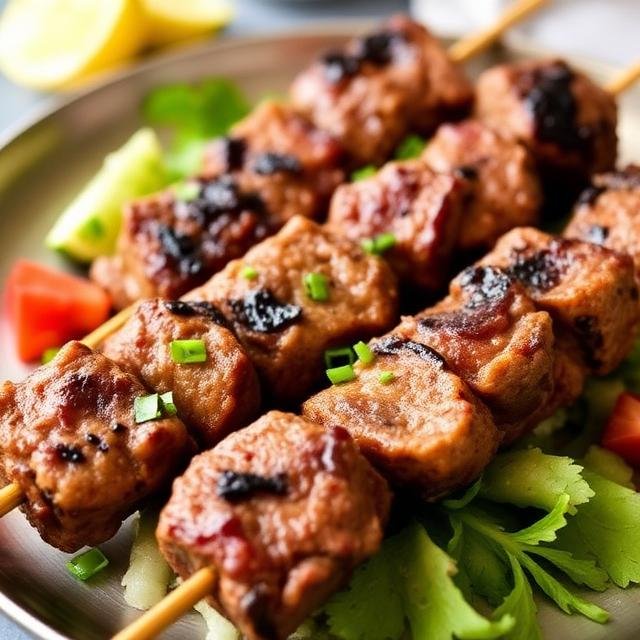
Country of origin: Iran
This round’s pick is kabab barg — thin, wide slices of marinated meat, traditionally tenderloin or a similarly tender cut, threaded onto skewers and grilled quickly over high heat. Alongside kabab koobideh and kabab torsh, both discussed elsewhere on this blog, it rounds out a picture of just how differently Persian grilling tradition treats meat depending on the specific kebab style, and it represents the whole-cut counterpart to koobideh’s ground meat approach.
The Name Describes the Shape Directly
“Barg” translates to “leaf” in Persian, a fairly direct reference to the thin, wide, leaf-like shape the meat is cut and pounded into before marinating and grilling, distinguishing it immediately by name from koobideh, whose name instead references the pounding technique used on ground meat, discussed elsewhere on this blog. This naming pattern, where different Persian kebab varieties are named after either their shape, their cut, or their preparation technique, reflects a fairly systematic and descriptive naming approach within Persian kebab tradition more broadly, in contrast to some of the more storied, legend-based dish names covered elsewhere on this blog, like umm ali or İskender kebab.
Why Whole-Cut Kebabs Demand a Completely Different Marinade Approach
Because kabab barg uses tender, whole slices of meat rather than ground meat, it requires an entirely different approach to both preparation and marination compared to kabab koobideh. Where koobideh’s ground meat relies on fat content and kneading technique to hold together on the skewer, as discussed elsewhere on this blog, kabab barg’s whole meat slices need to be specifically tenderized and flavored throughout via a marinade capable of penetrating solid muscle tissue rather than being worked directly into a ground mixture. The traditional marinade for kabab barg typically includes grated onion (whose juice, similar to its functional role in koobideh’s mixture, contributes to tenderizing here as well, though through a different mechanism when applied to whole meat), olive oil, saffron, and lime or lemon juice, and the meat is generally pounded thin before marinating, both to help the marinade penetrate more effectively and to ensure the meat cooks quickly and evenly over the kebab’s characteristically high, fast grilling heat.
A Kebab That Rewards Precise, Quick Cooking
Given how thin the meat is pounded and sliced for kabab barg, it cooks considerably faster than a thicker cut would, and getting the timing right matters more here than with many other grilled meats discussed on this blog, since the thin slices can go from perfectly cooked to overdone and tough within a fairly narrow window. This is part of why kabab barg is traditionally grilled very quickly over high, direct heat, generally just a few minutes total, rather than the longer, more gradual cooking time appropriate for a thicker cut or a denser ground meat kebab like koobideh.
The Recipe
Serves 4
Ingredients
- 2 lbs beef tenderloin or a similarly tender cut, sliced thin against the grain and gently pounded to an even thickness
- 1 large onion, grated (juice included)
- ¼ cup olive oil
- 3 tablespoons lime or lemon juice
- Pinch of saffron threads, dissolved in 2 tablespoons hot water
- 2 cloves garlic, minced
- Salt and black pepper, to taste
For serving:
- Saffron rice or flatbread
- Grilled tomatoes
- Butter, for topping the rice
- Sumac, for sprinkling
Instructions
- Prepare the meat. Slice the meat thin against the grain, then gently pound each slice between two pieces of plastic wrap to an even, thin thickness, similar to preparing a scaloppine.
- Make the marinade. In a bowl, combine the grated onion and its juice, olive oil, lime or lemon juice, dissolved saffron water, garlic, salt, and pepper.
- Marinate. Add the meat slices to the marinade, tossing well to coat every piece thoroughly. Cover and refrigerate for at least 4 hours, or up to overnight.
- Skewer the meat. Thread the marinated meat slices onto flat skewers, weaving them slightly back and forth along the skewer’s length rather than laying them flat, which helps them hold their position and cook evenly.
- Grill quickly. Heat a grill to high heat. Grill the skewers for just 2–3 minutes per side, watching closely, until the meat is cooked through but still tender — this cooks considerably faster than a thicker cut, so stay attentive to avoid overcooking.
- Rest briefly. Let the meat rest for a minute or two before serving.
- Serve. Serve over saffron rice with a pat of butter, alongside grilled tomatoes and a sprinkle of sumac.
A Note on Cooking Speed
Because the meat is sliced and pounded so thin, it’s easy to overcook kabab barg if you step away from the grill even briefly — stay close and check frequently, since the window between properly cooked and overdone is considerably narrower here than with most other grilled meats discussed on this blog.
Serving Suggestions
Kabab barg is often served as part of a mixed grill platter alongside kabab koobideh, giving diners a chance to compare the two very different textures — tender, whole-cut slices versus the denser, ground meat texture of koobideh — side by side on the same plate.
Kabab barg’s straightforward, descriptive name and its whole-cut approach round out a fuller picture of Persian grilling tradition — proof that “kebab” in Iranian cooking covers a genuinely wide technical range, not just a single format applied with different spices.