
Luqaimat: The Gulf’s Golden Fried Dumplings

Country of origin: Gulf region (UAE, Saudi Arabia, Bahrain, Kuwait, Qatar, Oman)
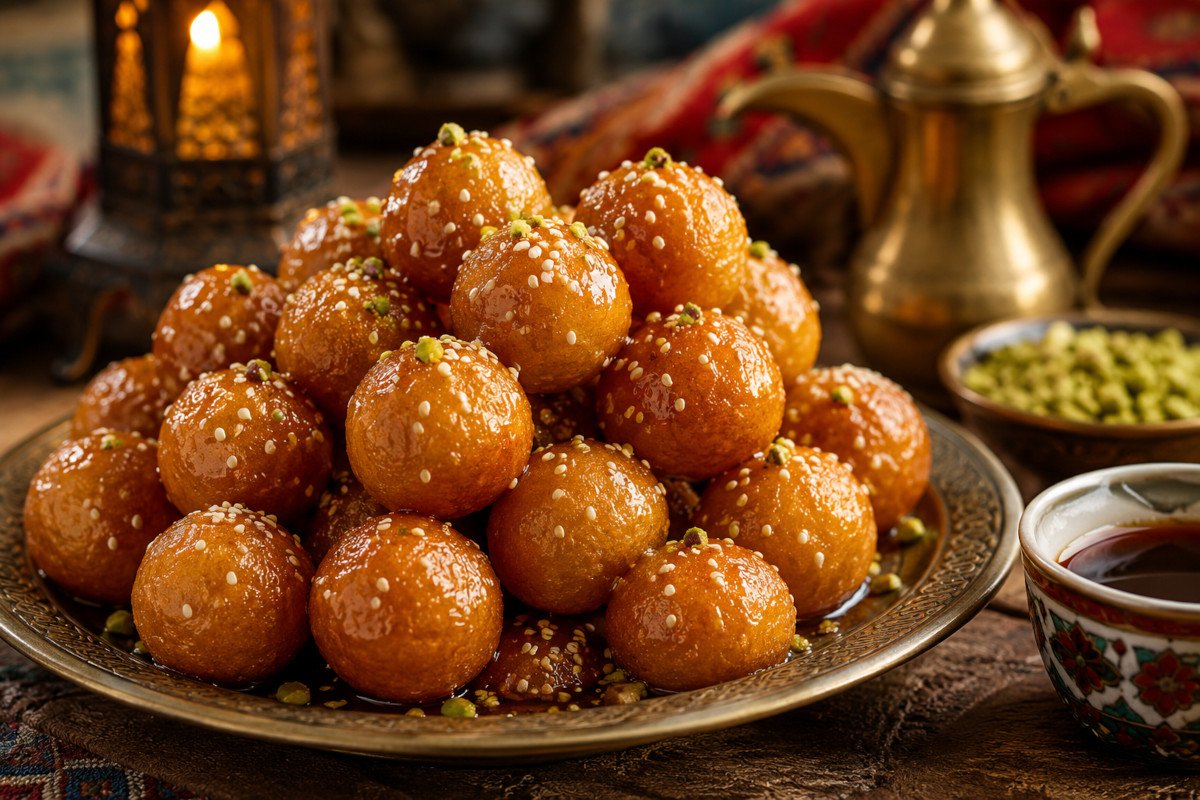
Today’s random pick lands on luqaimat (also spelled lgaimat or logeimat) — small, golden fried dough balls, crisp on the outside and soft within, drizzled with date syrup or a light sugar syrup and often finished with a scatter of sesame seeds. It’s one of the most beloved sweets across the Gulf states, and like harees, it holds particular significance during Ramadan, when it becomes especially common at iftar gatherings.
A Sweet Dumpling With Deep Regional Roots
Luqaimat’s name is generally understood to derive from the Arabic word for “morsel” or “small bite,” a fairly literal description of the small, bite-sized dumplings themselves. While pinpointing an exact date of origin is difficult, similar small fried dough balls soaked in syrup appear across a wide swath of the historically Arab and Persian-influenced world, with related desserts found from South Asia to the Levant, reflecting a broadly shared culinary concept of fried dough sweetened with syrup that appears in many forms across many cuisines. In the Gulf specifically, luqaimat has become a signature sweet strongly associated with Emirati, Saudi, Bahraini, and broader Khaleeji (Gulf Arab) home cooking and hospitality traditions.
Luqaimat holds a particular place in Ramadan tradition across the Gulf, where it’s commonly served at iftar gatherings, sold by street vendors setting up specifically for the occasion, and prepared in large batches for sharing among family and neighbors, similar to how certain seasonal sweets become closely tied to specific religious or cultural calendars elsewhere in the region.
Date Syrup: The Ingredient That Makes It Distinctly Gulf
While many syrup-soaked desserts across the Middle East use a simple sugar syrup, often scented with rosewater or orange blossom water, luqaimat is frequently finished with date syrup (dibs) instead, or some combination of the two. Date syrup’s inclusion reflects the deep historical importance of dates in Gulf cuisine and Bedouin food tradition more broadly, where dates have long served as an essential, calorie-dense staple suited to the region’s arid climate and historically nomadic lifestyle. Date syrup brings a deeper, more caramel-like sweetness and a slightly more complex flavor than plain sugar syrup, and its use in luqaimat is one of the clearest ways the dessert reflects specifically Gulf culinary identity rather than being interchangeable with syrup-soaked sweets from other parts of the region.
Why the Frying Technique Matters
Getting luqaimat right depends heavily on the batter consistency and frying temperature. The batter needs to be loose enough to form naturally round dumplings when dropped into hot oil, but thick enough to hold together and puff up properly rather than spreading out or falling apart. Oil temperature matters just as much: oil that’s too hot will brown the outside before the inside cooks through, leaving a raw, doughy center, while oil that’s too cool will result in dumplings that absorb excess oil and turn greasy rather than achieving the desired light, crisp exterior with a soft, slightly chewy interior.
The Recipe
Makes about 30 pieces
Ingredients
For the batter:
- 2 cups all-purpose flour
- 1 teaspoon instant yeast
- 2 tablespoons sugar
- ¼ teaspoon salt
- ¼ teaspoon ground cardamom
- Pinch of saffron threads (optional)
- 1 ¼ cups warm water (approximate, as needed)
- 1 tablespoon plain yogurt
For frying and finishing:
- Vegetable oil, for deep frying
- ½ cup date syrup (dibs), or a simple sugar syrup as an alternative
- Sesame seeds, for garnish
Instructions
- Make the batter. In a large bowl, whisk together flour, yeast, sugar, salt, and cardamom. If using saffron, steep it briefly in a tablespoon of warm water and add it to the mixture. Gradually whisk in warm water and yogurt until you get a smooth, thick, pourable batter — similar in consistency to a thick pancake batter, but sticky enough to hold a rough ball shape when dropped.
- Let it rise. Cover the batter and let it rest in a warm place for 1 to 1 ½ hours, until noticeably bubbly and slightly puffed, which helps the luqaimat achieve a light, airy interior once fried.
- Heat the oil. Heat about 3 inches of vegetable oil in a deep pot to 350°F (175°C). Maintaining a steady, moderate temperature throughout frying is important for even cooking.
- Fry the dumplings. Using a spoon or your hand (wetted with water or oil to prevent sticking), drop small portions of batter, about a tablespoon each, into the hot oil. Fry in batches, turning occasionally, for about 3–4 minutes, until deeply golden brown and cooked through.
- Drain. Remove with a slotted spoon and drain briefly on paper towels.
- Finish. While still warm, drizzle generously with date syrup and scatter with sesame seeds.
A Note on Batter Consistency
If your batter feels too thin and the dumplings spread out flat in the oil rather than holding a rounded shape, add a little more flour, a tablespoon at a time, until it holds together better when dropped.
Serving Suggestions
Luqaimat is best served warm, shortly after frying, while the outside is still crisp. It’s especially popular during Ramadan, but enjoyed year-round across the Gulf as an everyday treat with coffee or tea.
Luqaimat’s use of date syrup rather than plain sugar syrup ties it directly to one of the Gulf’s oldest and most essential ingredients — proof that even a simple fried dessert can carry a region’s culinary identity in a single finishing touch.