
Warak Enab: The Patience Dish of Stuffed Grape Leaves

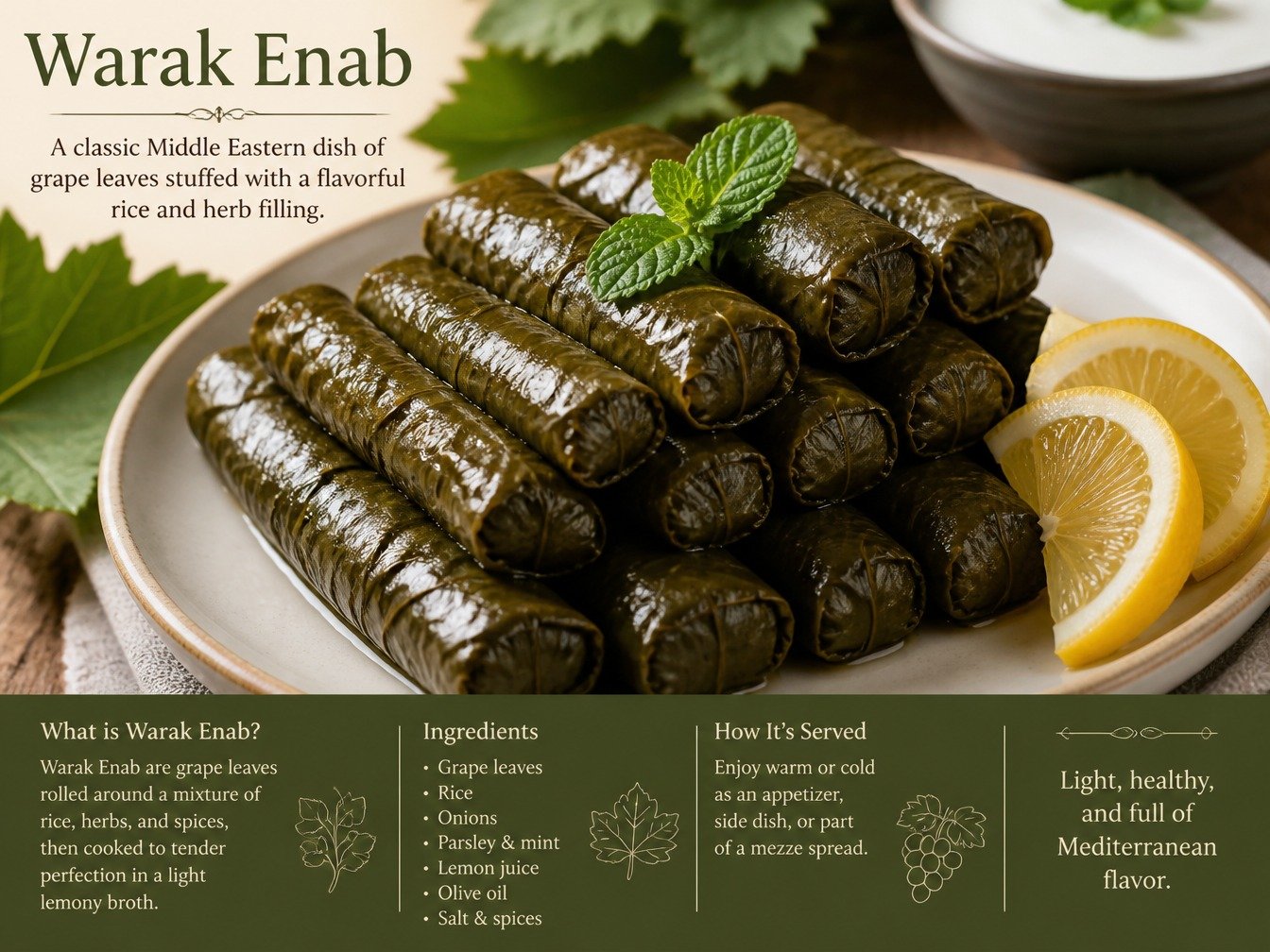
Warak enab (literally “grape leaves” in Arabic, also known as dolma across much of the former Ottoman world) — tender grape leaves rolled tightly around a filling of rice, herbs, and sometimes meat, then slow-simmered until soft. It’s a dish found, in one form or another, across an enormous swath of territory once connected by Ottoman trade and rule, and one where the sheer repetitive labor of rolling dozens of tiny parcels is as much a part of the dish’s identity as its flavor.
A Dish Shared Across a Former Empire
Stuffed grape leaves, under various names, appear across Turkey, Greece, the Balkans, the Levant, and the South Caucasus, all regions that were once part of, or closely connected to, the Ottoman Empire. The word “dolma,” used widely across Turkey and the Balkans, comes from the Turkish verb meaning “to be filled” or “stuffed,” and refers more broadly to a whole category of stuffed vegetable dishes, of which grape leaves are simply one variety — the same technique gets applied to peppers, zucchini, eggplant, and cabbage leaves across the region. In the Levant, “warak enab” refers specifically to the grape leaf version, and it holds a particularly central place in Lebanese, Syrian, Palestinian, and Jordanian home cooking, often prepared for large family gatherings precisely because of how labor-intensive it is to make in quantity.
The dish’s ultimate roots likely trace back even further than the Ottoman period, with some food historians connecting stuffed grape leaf traditions to earlier Persian and Byzantine culinary practices, both of which had their own histories of stuffed vegetable dishes well before Ottoman expansion helped spread and standardize the technique across such a wide geographic area.
Meat or No Meat: Two Distinct Traditions
Warak enab generally splits into two major variations, and the difference isn’t just about ingredients — it changes how the dish is served entirely. The vegetarian version, filled with rice, tomato, parsley, mint, and warm spices, is typically served cold or at room temperature, often as part of a mezze spread, with a generous amount of olive oil and lemon giving it a bright, tangy character suited to sitting out at room temperature. The meat version, usually filled with a mixture of rice and ground lamb or beef, is served warm as a main course, often cooked with lamb bones or ribs layered at the bottom of the pot, which flavor the cooking liquid and are sometimes eaten alongside the rolled leaves themselves.
Both versions rely on the same fundamental technique of rolling, but they represent genuinely different eating occasions — one a light, tangy appetizer, the other a hearty main dish — despite looking quite similar on the plate.
Why the Rolling Technique Actually Matters
Getting warak enab right depends heavily on rolling technique, more than on any complicated seasoning. Each leaf needs to be rolled tightly enough that it holds together and doesn’t unravel during the long simmer, but not so tightly that the rice filling — which expands as it cooks — has no room to grow, which can cause the leaves to burst open. This balance takes practice, and it’s part of why the dish is often associated with skilled home cooks who can roll dozens of tightly, evenly wrapped leaves with real speed and consistency, a skill built through repetition rather than any single trick.
The Recipe
Serves 6 (makes about 40 rolls)
Ingredients
For the filling:
- 1 cup short-grain rice, rinsed
- 1 large tomato, finely diced
- ¼ cup fresh parsley, finely chopped
- 2 tablespoons fresh mint, finely chopped
- 3 tablespoons olive oil
- 1 teaspoon salt
- ½ teaspoon black pepper
- ½ teaspoon ground allspice
- ¼ teaspoon cinnamon
For the leaves and pot:
- 1 jar (16 oz) preserved grape leaves, rinsed and drained (or fresh grape leaves, blanched briefly to soften)
- 3–4 lamb bones or a few thin lamb rib pieces (optional, for a meat-style version)
- 3 cloves garlic, thinly sliced
- 3 tablespoons olive oil
- Juice of 2 lemons
- 2–3 cups water or broth
Instructions
- Prepare the filling. In a bowl, mix the rinsed rice, diced tomato, parsley, mint, olive oil, salt, pepper, allspice, and cinnamon until well combined.
- Prepare the leaves. If using jarred leaves, rinse well to remove excess brine. If using fresh leaves, blanch briefly in boiling water for about 30 seconds until softened and pliable, then drain.
- Roll the leaves. Lay a grape leaf flat, vein-side up, with the stem end facing you. Place about a teaspoon of filling near the stem end. Fold the sides in over the filling, then roll tightly away from you into a small, compact cylinder, similar to rolling a small cigar. Repeat with the remaining leaves and filling.
- Line the pot. If using lamb bones, arrange them across the bottom of a wide pot — this protects the delicate rolls from direct heat and adds flavor to the cooking liquid. If not using bones, line the bottom of the pot with a few torn or less-than-perfect grape leaves instead, for the same protective purpose.
- Arrange the rolls. Layer the rolled grape leaves snugly in the pot in tight, concentric circles, packing them closely so they hold their shape during cooking.
- Add liquid. Scatter the sliced garlic over the top, drizzle with olive oil and lemon juice, then pour in water or broth until it just covers the rolls. Place a small heatproof plate directly on top of the rolls to weigh them down and keep them from unraveling as they cook.
- Simmer. Bring to a gentle boil, then reduce heat to low and simmer, covered, for 45 minutes to 1 hour, until the rice is fully cooked and the leaves are tender.
- Rest and serve. Let the pot sit off the heat for 10–15 minutes before serving, which helps the rolls firm up slightly and makes them easier to remove intact.
A Note on Rolling
Your first several rolls will likely be uneven, and that’s completely normal — rolling technique improves quickly with repetition, and even imperfectly rolled grape leaves taste just as good, even if they’re not as visually tidy as ones made by an experienced cook.
Serving Suggestions
The vegetarian version is best served cold or at room temperature with a squeeze of extra lemon, as part of a mezze spread. The meat version is served warm as a main course, often alongside the cooked lamb bones or rib pieces from the pot.
Warak enab is a dish built on patience and repetition — proof that some of the most satisfying foods in the region come not from complex flavors, but from a simple technique performed dozens of times over.