
Sabich: The Iraqi-Jewish Sandwich That Became an Israeli Icon

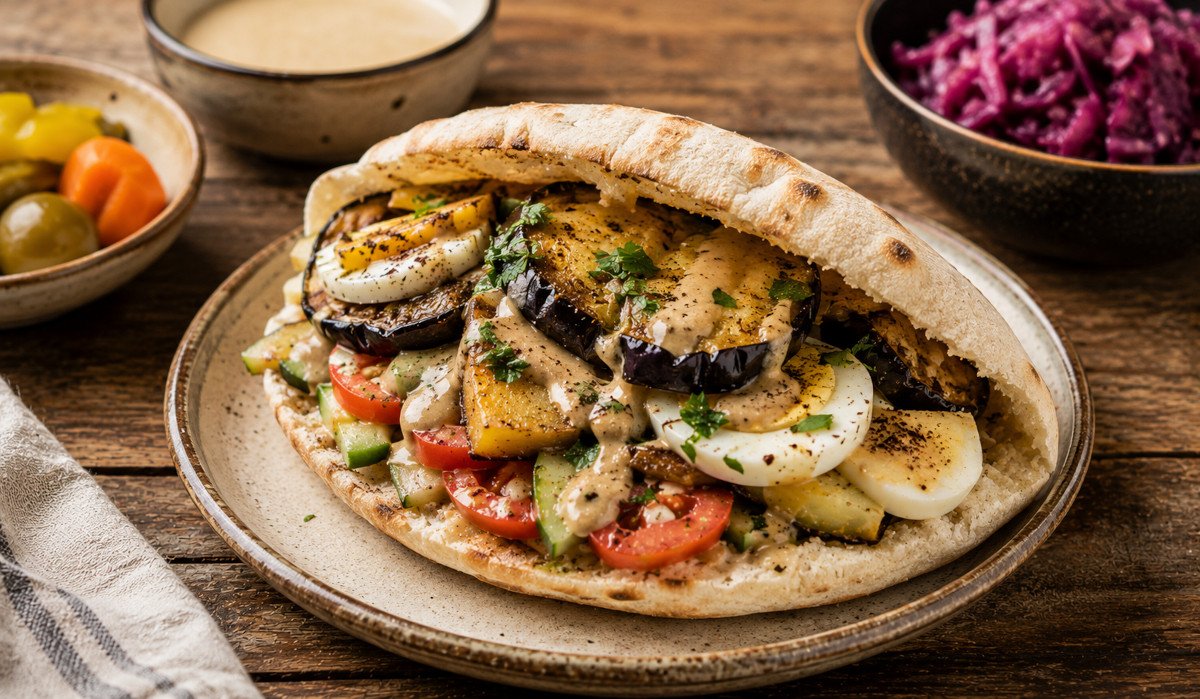
This round covers Israeli cuisine with sabich — a pita sandwich piled with fried eggplant, hard-boiled egg, hummus, Israeli salad, and a distinctive tangy mango pickle called amba. It’s one of the clearest examples of how Israeli food culture has been shaped by waves of Jewish immigration from across the Middle East and North Africa, since sabich didn’t originate in Israel at all — it arrived with Iraqi Jewish immigrants and became something new once it did.
A Sabbath Breakfast That Became Street Food
Sabich traces its roots to the Iraqi Jewish community, where a dish of fried eggplant and hard-boiled eggs was traditionally eaten as a Saturday breakfast. The connection to Shabbat is central to understanding the dish: because cooking is traditionally avoided on the Sabbath itself, the eggplant would be fried in advance, and eggs would be slow-cooked overnight (a method related to the long-cooked eggs known as hamin eggs across Sephardic and Mizrahi Jewish cooking), so the meal could be assembled and eaten without any Sabbath-day cooking.
When large numbers of Iraqi Jews immigrated to Israel following the establishment of the state in 1948 and the subsequent upheaval faced by Jewish communities across Iraq, they brought this dish with them. In Israel, it was reimagined and popularized as a stuffed pita sandwich — most famously by Iraqi-Jewish vendors in Ramat Gan, near Tel Aviv, in the latter half of the 20th century. From there, it spread across the country and became one of Israel’s most recognizable street foods, sold from dedicated sabich stands much the way falafel or shawarma are.
Amba: The Ingredient That Ties It Together
If there’s one component that defines sabich’s flavor, it’s amba — a tangy, tart, mustard-and-turmeric-spiced mango pickle sauce, itself a dish with Iraqi Jewish roots, believed to have been influenced by South Asian mango pickles encountered through trade routes and later adapted into Iraqi Jewish cooking traditions before making the same journey to Israel. Amba’s sharp, sour, slightly funky flavor is what cuts through the richness of the fried eggplant and hummus, playing a similar role to how tahini or pickles might function in other Middle Eastern sandwiches, but with a completely different, more assertive flavor profile.
Without amba, sabich is a good sandwich; with it, it becomes the specific, recognizable dish that regulars line up for.
The Recipe
Serves 4
Ingredients
For the fried eggplant:
- 1 large eggplant, sliced into ½-inch rounds
- Salt, for drawing out moisture
- Vegetable oil, for frying
For the eggs:
- 4 eggs, hard-boiled and sliced
For assembly:
- 4 pita breads
- 1 cup hummus
- 1 cup Israeli salad (finely diced tomato, cucumber, onion, olive oil, lemon juice, salt)
- ½ cup amba sauce (store-bought, or see note below)
- ¼ cup tahini sauce (tahini thinned with water, lemon juice, and a pinch of salt)
- Pickled vegetables (optional)
- Fresh parsley, chopped
Instructions
- Salt the eggplant. Lay the eggplant slices on a rack or paper towels, sprinkle generously with salt, and let sit for 20–30 minutes to draw out excess moisture and bitterness. Pat dry.
- Fry the eggplant. Heat about ½ inch of vegetable oil in a wide pan over medium-high heat. Fry the eggplant slices in batches for 3–4 minutes per side, until deeply golden and tender all the way through. Drain on paper towels.
- Prepare the eggs. If not already boiled, hard-boil the eggs (about 9–10 minutes for a fully set yolk), cool, peel, and slice.
- Make the tahini sauce. Whisk tahini with water gradually until smooth and pourable, then add lemon juice and salt to taste.
- Assemble the sandwich. Warm the pita and cut open to form a pocket. Spread a generous layer of hummus inside, then layer in fried eggplant slices, sliced hard-boiled egg, and Israeli salad.
- Add the finishing sauces. Drizzle generously with tahini sauce and amba. Add pickled vegetables if using, and finish with a sprinkle of fresh parsley.
A Note on Amba
If you can’t find prepared amba, a quick approximation can be made by simmering diced green mango (or a firm, under-ripe regular mango) with vinegar, mustard seeds, turmeric, a little sugar, salt, and chili flakes until softened, then blending into a thick, tangy sauce. It won’t be identical to the traditional fermented version, but it captures the essential sour, spiced flavor.
Serving Suggestions
Sabich is a complete meal on its own, best eaten fresh and warm right after assembly, while the pita is soft and the eggplant is still slightly crisp at the edges.
Sabich carries the story of an entire community’s migration inside a single sandwich — a Saturday breakfast from Baghdad that became a Tel Aviv street food staple.